In Japan again with my family. Our pineal glands are adjusting their melatonin secretions and we expect to recover locally appropriate circadian rhythms soon. Meanwhile, one is up at 1 A.M., another at 3 A.M., and the others at 5 A.M. Five is actually reasonable since the sun is up at that time. Another little-known advantage is that you can also catch the last hour of All Things Considered here on a regular clock-radio at that time, with no need to subscribe to the podcast.
Aside from the jet-lag and weather adjustments, I found out that the 2 batteries I have for my PowerBook may burst into flame in a few rare cases and need to be replaced. Even if it doesn't crash, it burns. It's a Sony. I mean "The batteries are Sonys." Maybe Apple should use a more reputable manufacturer like Samsung or LG next time. At least I can wait for the replacements to be delivered and then send in the old ones. This (getting 2 new replacement batteries) could actually be a good thing.
Friday, August 25, 2006
I'm Back
Tags: blogging, Land of the Rising Sun, NiHon, technology, travel, weather
-
Blues Tea-Cha
-
5:11 PM
0
comments
Wednesday, August 09, 2006
Nontanoshippa のんたのしっぽ 第1話
Japanese video of the day.
You'll need to see the conclusion(?) in part two:
Tags: art, Japan, Land of the Rising Sun, video
-
Blues Tea-Cha
-
12:50 PM
0
comments
Tuesday, August 08, 2006
All that killin' and rapin' makes our boys hungry
I'm in Vancouver. It is a light non-accumulating precipitation kind of day, when the rain keeps falling but the sidewalk never gets wet, somehow. Light jackets and unbrellas optional.
Today has been a nightmare come true for the purveyors and marketers of american-style grilled chicken wings everywhere.
Update: It turned into real rain.
I wonder if the 21st century will be remembered as the century of religious wars. The Islamofascist Parties of Gods versus the Christofascist One-nation Undergod and the Judeofascist Chosen People (not Korea). If so, can I be frozen and woken up next century? Maybe I should stick around and join in with my own Twenty Three Thousand Armed Buddhas, the Guerilla Armies of the Goddless, or the Definitely Maybe Usually Agnostics Liberation Front. My present strategy is to sit it out and let the crazies kill each other, but will they kill all of us?
Tags: politics, Republic of Armed Desire, survival
-
Blues Tea-Cha
-
5:25 PM
0
comments
Friday, August 04, 2006
Rio Karma (and the POS Seal of Disapproval)


I liked Rio's MP3 CD players. They were cheap and you could load a dozen albums on one disk. Bulky, though. When I wanted a smaller (than CD) MP3 player, about 3 years ago, I got the Rio Karma. I hated all the DRM in iPods and the control freak mother attitude embedded in Apple's iTunes system, which is still not up to the SoundJam MP standard of 2000 C. E. Rio could share files using a Java application, it acted as a server on the network, and it was endlessly configurable. I chose it over an iRiver I was considering.
Later, I was given an iPod shuffle and I never looked back. The DRM is annoying and stupid, since you can only sync it with one computer, but I try to deal with that. I have been given a Nano, too, that I am saving to use for photos or something else later, since the low-budget shuffle is still working fine for me.
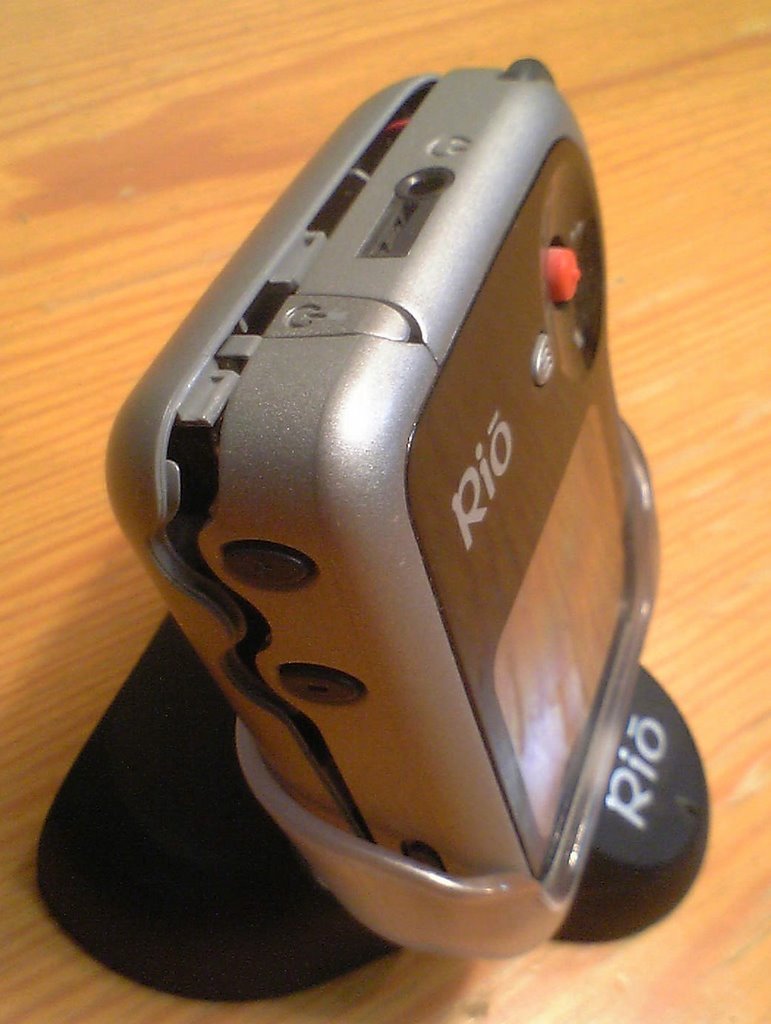
These photos show what happens to a Karma after 3 years. The battery swells up and bursts the case open. I dissected it to find that out. It doesn't hold a charge, either, in case you wondered, and freezes up when run off the wall current. It is truly a POS, unless you like your electronics engineered to last one or two years rather than a more reasonable length of time.
Rio has gone out of the mp3 player business, so you won't be buying one. I wonder how iPods will age. They certainly have been built to last -- all summer long-- as the saying goes.
Tags: audio, music, technology
-
Blues Tea-Cha
-
7:15 PM
0
comments
God told me to do it! (a short message from your personal savior)

Feeling angry at the crazies who are saying that God tells them to kill babies? Well, I am, too, and although these are not aimed specifically at the "parties of gods" and partygoers in their various manifestations, they do help to remind you to regard with skepticism those people who claim they hear God, see God, or are God's organization on Earth. (Thanks, Erik.)
-
Blues Tea-Cha
-
2:57 PM
0
comments
11th and C
In 1981 I lived in Manhattan at the corner of 11th and Avenue C, at 649 E. 11th Street, on the top floor of a walk-up. The building apparently pre-dated the invention of the elevator. I had a corner room with a good view of the World Trade Center over the burned-out building across the street. The building had a spray-painted black plexiglass door with an peephole area that had been scratched clean with a razor blade. The dealers kept a doorman there, another guy on the street next to a barrel of burning wood scraps or trash, and another guy at the corner as a lookout. A couple of flights up the stairs they would be dealing, mostly junk, and sometimes the dealers let the customers shoot up there, candle, spoon, the whole works.
Why was I there? I was bored of the midwestern small university town and shocked by the murder of John Lennon and election of actor Ronnie Reagan. New-York based punk rock musicians and leftist political philosophies may have influenced my choice to be there. Cost-wise, there was a sharp devaluation from 1st Ave. to Avenue A and then down to C that made it extremely affordable to venture farther east, about a 75 or 80% discount over 2 or 3 blocks, if you wanted to live in Manhattan rather than Queens or Brooklyn.
The neighborhood was mostly Spanish-speaking Puerto-Ricans, poor native New Yorkers, and small numbers of artists, musicians, and punks. I shared the living room with my friend, Pete. I separated my room with a California Republic flag I had found outside a suburban San Diego police station, and slept under an American flag from the same source. Sorry, officers. Youthful indiscretion. Statute of limitations is expired, isn't it?
We furnished the place with stuff off the streets: a sofa with a broken leg, artificial christmas tree, plaster madonna with broken-off head, a chest of drawers. Yes, we carried this stuff up 8 flights of stairs. I turned 18 while I was there. When we got sick of some furniture, like the chest of drawers, we would wait for the street below to get really quiet late at night, and then hurl it out the window.
We would sometimes be asked to show our "tracks" before being let in, and have to tell the doorman that we lived there. There was never any violence, as I remember. There was crime; when the dealers were not there we usually got broken into. Occasionally someone in the neighborhood would try to hold us up with a knife.
I never ventured far from Manhattan in the year I was there. The farthest I went was probably Jones beach and inside the crown of the Statue of Liberty. I was an avid urban hiker already then, walked all over the city, through the Bowery and Chinatown down to Wall Street and Battery Park, through midtown and to Central Park. From 11th to Central Park is really too far, though.
Within a year, it was clear that I wasn't going anywhere, and didn't have much more to learn from this place. I thought NYC would always push me down, too many rich and too many poor. The clincher came when the building caught fire, twice. The first time we discovered it in the apartment under ours. The second time alot of the doors were broken in with axes, windows were broken as people got onto the fire escapes, and some of the slate steps collapsed. Some of the steps were then holes, which you could step over, but some of the landings also collapsed, which made going up or down 8 flights pretty weird, as you had to hold onto the railing and swing your body 180 degrees over a huge drop. Then I think they cut off the water, so you had to visit friends just to bathe, and most of the residents went on a rent strike and were demanding that repairs be made. I didn't stick around to see how it all turned out. I stayed at my girlfriend's until I could go back to university, where I was still an honors student from the 4.0 GPA I somehow got in my first semester. I got this new idea that maybe getting a loan to go to university really was better than working for minimum wage and living in a slum. (I tend to learn by doing. I got to feel it in my gut.) Within less than a year, I had moved on to Los Angeles, but that is another story.
The reason for this story? I have never been back to New York since I left in 1981. I have wanted to see a picture of that neighborhood for a long time, if I can't go there. I decided to google up 649 East 11th Street for the first time in… maybe ever, and googled 647 instead. Why did I do that? Somehow "647" has a stronger trace in the universal mind matrix, I guess. I then discovered that there is now a Japanese sake bar called Kasadela on the site next to where I lived. Kasadera means Umbrella Temple, and it is a temple-town on the Tokaido near Nagoya. I also learned that the musical Rent is supposed to take place at 11th and B, and that Dustin Hoffman, Jane Curtin, and the Black Liberation Army have a history on Eleventh Street. (Not all together as part of the same incident, though. They all lived there.) I found some decent pictures of the restaurant interior and exterior here. Although they don't have sushi, they do have grilled eel over rice, Unagi-don on the menu! I want that and plenty of sake to wash it down. Unfortunately, I am 11 (or 13) time zones away. If I am in the neighborhood, I will stop in.
"The Alphabet" had a pejorative sound in those days. We called it the Lower East Side and sometimes Loisada(?). "Alphabet City" seems to have decent connotations now (but what do I know). It is a major mental hurdle to imagine the neighborhood has changed that much. We were the pioneers, I guess. The few, the proud, the idiots.
Tags: cities, freedom, history, New York City
-
Blues Tea-Cha
-
11:17 AM
0
comments
Thursday, August 03, 2006
Two Things with Wings
DARPA has Lockheed Martin building "spy seeds".
Yellow-jacket nests the size of a Chevy. Bees evolve mega-cities. Sweet home Alabama.
Via Aberrant News
Tags: blogging, Earth, evolution, technology
-
Blues Tea-Cha
-
8:38 PM
0
comments
Blogs, news, and bookmarks
I neglected to mention that the US Senate still has to approve DOPA, so contact a Sedator to undo what your Reprehensible has tried to do. This legislation would block up the system of tubes known as the internets.
I see that the Indian blog blackout was reported by BoingBoing a few weeks ago, on the 17th, by the BBC on the 19th, and by, for example, the Financial Express on the 24th of July. OK, so I am a little out of the loop. I've been getting my news from CNN, from Wolf Blitzkrieg's Situationist Room, Anderson Cooper's 360 Degree VR, or something like that. So, whatever happened with the blog block anyway? Everybody found a hack or workaround by now? I will look into it.
What has changed with my news sourcing is that I now trust blogs more than the other (slipstream and cashstream) media. I wouldn't have said that a year ago. The seeds of doubt were planted by Jayson Blair, Judith Miller, and Bob Woodward (implicated in the Plame affair), reporters at the reputable(?) newspapers of the NYT and the Washington Post. The media reaction to Stephen Colbert's speech at the Nationalist Press Klub cemented my growing inclinations to withhold trust. Also note above in the preceding paragraph how the blogs report news before the cash-stream media does. A blogger is just your personal choice(s) of editor, among other things (columnist, diarist, essayist, unpaid volunteer, writer, correspondent, etc.).
I trust blogs more than other media, but I don't necessarily read many blogs. The few blogs I have sidebarred(?) here are ones to which I want to return, sorta like a bookmark. I have this time-consuming thing called a job, and then a family, too. One of my favorite blogs, ThisModernWorld, I only get to every ten weeks or so, then go back to read the last ten comic strips. Funny how "Tom" wasn't political at all back when I knew him in the 80s, but is actually a little too political, for my tastes, this last
decade or so.
And, speaking of bookmarks, I have been waiting for a good free bookmark manager to come along since about 1998, by which time I had accumulated an unwieldy list of bookmarks. I expected something that would update outdated links, delete nonexistent ones, map them into some kind of semantic web of lexical analysis (maybe based on the Dewey Decimal system or some thesaurus), etc. Nothing like that ever came along, and I think everyone else has also turned to Google. Sometimes Google can't get me back to somewhere I was before, if I can't remember any uniquely aberrant words from the site, though.
Tags: Asia, blogging, computers, freedom, media, Republic of Sacred Cow, technology
-
Blues Tea-Cha
-
6:20 PM
0
comments
The World Wide War on … blogs?
Simran reports from India that India is now blocking most popular blogging sites:
Our lovely government, the government of India has BLOCKED all .blogspot.com, .typepad.com, geocities.com/ blogs and web-sites. There are more on the list, but these are the three, that all the media is agreeing on. I am in India, and I’m confirming it.Meanwhile, back in the USA, the House of Reprehensibles has passed (by 410-15!) DOPA, which will make it illegal for schools and libraries to allow access to blogs, wikis, and sites with editable profiles. The opposition of the American Library Association didn't seem to matter.
"This unnecessary and overly broad legislation will hinder students' ability to engage in distance learning and block library computer users from accessing a wide array of essential Internet applications including instant messaging, email, wikis and blogs," said ALA president Leslie Burger. "Under DOPA, people who use library and school computers as their primary conduits to the Internet will be unfairly blocked from accessing some of the web's most powerful emerging technologies and learning applications. As libraries are already required to block content that is "harmful to minors" under the Children's Internet Protection Act (CIPA), DOPA is redundant and unnecessary legislation."Some observers have noted that, as worded, this ban includes e-commerce sites such as Amazon and ebay.
You probably couldn't find a better argument against this legislation than the one offered by CBS's Larry Magid:
The bill defines social networking sites as being "offered by a commercial entity; permits registered users to create an on-line profile that includes detailed personal information, permits registered users to create an on-line journal and share such a journal with other users; elicits highly-personalized information from users; and enables communication among users."This affects me personally, since I have just started using blogs for students to publish, read, peer edit, and revise their writing. (Me is tea-cha, after all.) Hopefully Japan will not follow China, India, and now the United States into the black hole of internet censorship.
That covers more than just chat and social networking and could force school and library officials to ban a wide range of sites, including Amazon.com and many news sites that allow for user feedback and interaction.
But even if the bill weren't overly broad, it would still be troublesome because it is the wrong – and I would argue a dangerous approach – to Internet safety.
While nearly everyone agrees that Internet predators should be "deleted," this bill doesn't address that issue. Unlike the Adam Walsh Child Protection and Safety Act of 2006, which the President signed into law on July 21, DOPA does nothing to strengthen penalties or increase prosecution of criminals who prey on children. Instead, it punishes the potential victims and educational institutions chartered to serve them, by denying access to interactive sites at school and libraries.
It would be like trying to protect children from being injured or killed by drunk drivers by ruling that kids can no longer walk, ride a bike or even ride in a car or bus to school.
Aside from punishing potential victims rather than the perpetrators, the bill doesn't even address the issue where it matters.
If children are going to get into trouble online, chances are it won't be at school. They'll be home, they'll be at a friend's house or they could even be completely away from adult supervision using their mobile phones. Schools and libraries are relatively protected environments where adults are never far away and, for the most part, computers are in public locations that make it difficult for users to hide what they're doing.
If anything, schools and libraries should be encouraging kids to use blogging and social networking services. They have enormous educational potential for such things as writing, interviewing, collaborative research, media literacy, and photography, but even if not used as part of a formal supervised education program, they encourage kids to communicate and reach out to others.
It's odd (or fitting?) that this move comes just as MySpace becomes the #1 internet portal in the United States. The internet is a new medium that still eludes government control. Social networking and communication are threats to the ruling elite's media control. It is predictable that they will continue to try to control this channel. Paranoid delusion number 200,608,031,538 tells me that "they" are data-mining all the e-mail and internet traffic to construct a model which will tell them where to send the death squads, if real democracy ever threatens to break out. (Is Google a CIA front?) Stand up, though! They will never be able to kill all of us!… Well, not until the mass production of robots really takes off. (Is a christo-fascist zombie man or machine?)
Tags: blogging, democracy, Earth, education, India, media, Republic of Sacred Cow, survival, technology
-
Blues Tea-Cha
-
3:11 PM
0
comments
Gibbon arrested, charged, may seek political office
Feeding rumors of a run for the White House in '08, Hollywood actor Malik "Mal" Gibbon (a pseudonym is used to protect his privacy) has recently been arrested for DUI. Driving-under-the influence-of-alcohol arrests were also important millstones in the political careers of chimperor G. W. Bush and Vice Executioner Halliburton "Dick" Cheney. Although Mr Gibbon has no requisite record of avoiding military service, another important qualification for the post, he is suspected to be of "foreign" extraction. In recent years Americans have turned away from corrupt and incompetent home-grown kleptocrats and sought out escaped musclemen from Austrian circuses and/or actors to manage their nation's increasingly complex "innernaschnull" and "nukyular" affairs. The actor's foreignness, drunkenness, bigotedness, and heavily documented dedication to Jeezus are all factors that are causing Repugnicant Particals in the Base, the Party of God (G.O.P.) to take a closer look at the profile of this rising star.
(Pic googled from the Smoking Gun)
Update: I see that somebody of the one mind has crafted their own Mr Gibbon before I thunk it.
Tags: intolerance, religion
-
Blues Tea-Cha
-
1:55 PM
0
comments
Sunday, July 30, 2006
Pirahã
A friend showed me this abstract last year:
The Pirahã language challenges simplistic application of Hockett's nearly universally accepted design features of human language by showing that some of these features (interchangeability, displacement, and productivity) may be culturally constrained. In particular, Pirahã culture constrains communication to nonabstract subjects which fall within the immediate experience of interlocutors. This constraint explains a number of very surprising features of Pirahã grammar and culture: the absence of numbers of any kind or a concept of counting and of any terms for quantification, the absence of color terms, the absence of embedding, the simplest pronoun inventory known, the absence of "relative tenses," the simplest kinship system yet documented, the absence of creation myths and fiction, the absence of any individual or collective memory of more than two generations past, the absence of drawing or other art and one of the simplest material cultures documented, and the fact that the Pirahã are monolingual after more than 200 years of regular contact with Brazilians and the Tupi-Guarani-speaking Kawahiv.From Cultural Constraints on Grammar and Cognition in Pirahã in Current Anthropology, volume 46 (2005), pages 621–646. PDF
Pirahã is also one of the few languages in the word that can be whistled, since tones carry most of the information.
Here are some other relevant links:
http://www.socioambiental.org/pib/epienglish/piraha/ling.shtm
http://en.wikipedia.org/wiki/Múra-Pirahã_language
PIRAHA AND WHORF
http://en.wikipedia.org/wiki/Whistled_language
Tags: humanity, language, numbers
-
Blues Tea-Cha
-
1:31 AM
0
comments
Media clichés on the brink, at the pump.
Jon Stewart observes the overextended "brink" of war, and Americans "feeling it at the pump".
Tags: language, media, politics
-
Blues Tea-Cha
-
12:22 AM
0
comments
Wednesday, July 26, 2006
Me and My Monkey
Just what you need: a system that embeds an IC chip in your local monkey so you can get an e-mail when saru-san nears your home.
NTT West Corp., meanwhile, is developing a system in which integrated circuit tags can be placed on monkeys in the area to keep track of their whereabouts. When the tags--and therefore the monkeys--approach a field, the IC chips will inform locals by sending an e-mail to their cell phones.From the DY story under a headline that reads: Pesky Critters Plague Farmers (Use a voice from one of the Beverly Hillbillies --preferably Granny-- when you say that.)
Update 2006.07.27:
The more I think about it (and I have a long commute with nothing better to do than listen to npr now that Marc Maron is off the air again), the less sense this story makes. Shouldn't the notification e-mail from the monkey be sent to the dog, not the farmer? The farmer, after all, could be off at the feed store, in town, over at his cousin's, or working another field. Not to mention that most rural areas are outside the range of cell phones, anyway. The dog could have a cellphone collar that would give a bowlingual version of the message, specially crafted to appeal to the dog's sense of adventure and love of military hierarchy. "K-9 Unit 1! Simian Intruder in Sector 7! Peaches and lettuce threatened! Report at once, and repel intruder!" The kennel could be automatically unlocked at that point.
Or is this monkey-vs-farmer (agrosimian? What's the adjective here?) issue really a telecommunications problem? Just as every problem looks like a nail if you are a hammer, every problem looks like a telecommunications problem if you are NTT. It seems like we could all take the advice of progressive rocker Peter Gabriel and just "Shock the Monkey", if that is OK with everybody. Am I missing something? If you implant the IC chip, why not wire the monkey's pain and pleasure centers, to create a monkey cyborg? Wouldn't that be better than being pestered with monkey mail?
Some readers (or "my one reader") may wonder why I am wasting my time considering this issue, while Southwest Asia (a.k.a. "Middle East" in early British colonial-speak) is at war. Rest assured that considerable neuronal resources are being directed at this problem as well. Current solutions under consideration do not involve the use of cyborg monkey armies, although I will concede that such solutions are underutilized in contemporary military practice, particularly Iraq, where the National Guard is a poor substitute for the robust and flexible simian intellect. My solutions will be revealed shortly, when the world is a little riper and readier for them. I should probably delete my profile, go under deep cover, so that Mossad, Hiz'b'allah, or Halliburton "Dick" Cheney doesn't come to slit my throat. Not to worry, though, my solution is so sensible and reasonable that it will not be able to receive serious consideration by the reality-impaired principle parties to the dispute.
Tags: animals, Japan, technology
-
Blues Tea-Cha
-
12:02 AM
0
comments
Tuesday, July 25, 2006
Chickenheads in Marketing
Harry Shearer reports on le show that KFC has appropriated a famous Daoist (a.k.a. Taoist) priest in an attempt to sell more chicken sandwiches. This disregards the famed vegetarianism of the Daoists and offended people across China. Don't these people think about running these ideas by a test audience, just to see how they react, before they go nationwide –to an audience of 1,300,000,000 people? China Daily is complaining, the story was reported in the Independent, and UPI has it, too.
Tags: Asia, food, Middle Kingdom, ZhongGuo
-
Blues Tea-Cha
-
2:41 PM
0
comments
Sunday, July 23, 2006
Eely-Feely
I didn't know until today, but this is the day (midsummer day of the ox) for eating eel to boost your summer heat tolerance. Apparently this belief is an artefact of an advertising campaign of the Edo period. (Hey, I wonder what advertising jingles that I imprinted in my childhood will still be part of the culture in 2270? C&H pure cane sugar, from Hawaii, wonder-bread helps build strong healthy tumors 12 ways, it's the real thing, where's the beef, uh-oh, spaghettio!? I remember those as well as I remember Aesop or Mother Goose. But will I transmit them to coming generations? Maybe I already am!)
Anyway, I was hungry for eel (unagi) this week, and went out in the pouring rain of this incessant Blade-Runner-esque rainy season to try to buy, an unagi bento. I found one at 7-11, but the price was an unreasonable ¥1300, 2 or 3 times a normal lunch box. I switched to getting an unagi onigiri (eel rice ball) instead, for a still-expensive ¥220, double the price of your typical nori-wrapped onigiri. There seems to be an acute shortage of eel this year, as today's DY reports. While searching for other eel news headlines, I found that the JT has some eel-related vocabulary in their eel restaurant reviews that you could try out when you visit your local eelateria. If you don't even like seafood and were hoping this was about EELS, why don't you go there, instead?
Tags: food
-
Blues Tea-Cha
-
1:19 PM
0
comments
Public Safety, Peace, and Social Justice
It's something I sometimes go years without thinking about, but this week, as I found myself returning home after midnight several times, I was impressed by the level of public safety in metropolitan Tokyo. The trains I have been on this last week, even on Friday night, were not filled with inebriated salariman, but with office workers returning home from working overtime or from going out for dinner and drinks, nearly half of them young or middle-aged women, in their 20s to 40s (presumably lightly armed).
Just for a moment, it seemed amazing that trains packed with commuters can arrive, not just late at night, but after midnight, and that thousands of women can walk safely home from the station alone, even in heels, and not even think about being afraid for their personal safety.
This is the situation, not just in one neighborhood, but in every neighborhood of this city, and every other city in Japan. I think we could find a few similarly safe neighborhoods in the (smaller) American metropolises of New York City, Los Angeles, or Chicago, but not entire cities or states with a comparable level of public safety.
Sure, there is the occasional nutcase with a kitchen knife on a bicycle, stabbing multiple victims, but in a city of 20 million, you have to expect one or two people to wig out every once in a while.
The Japanese are aware that public safety in Japan is better than most other places, and they are proud of it. The foreign is seen as a dangerous place. Too much safety makes Japanese lacking in street smarts and protective paranoia.
Their own explanation tends toward the racist: we Japanese are one people, one ethnic group, therefore safe. Foreign police forces, enviously attribute the public safety to the Koban system of public policing.
I have always attributed this to the destruction of the class (and lingering caste) differences in the post-war period of occupation and social reconstruction. The new society was much more equal, and hence more democratic. Equality led to less crime.
Similar post-war redistributions of wealth in places such as West Germany and Britain led to crime rates that were much less than the United States as well. The IRA and Baader-Meinhof are exceptions that existed for different reasons and don't change the relative statistical differences.
Free or inexpensive public services such as education, health care, day care, and the like also enhance the relative equality of income. Estate taxes as high as 50% whittle away the excessive accumulated wealth of the hyper-rich.
As the Japanese are now restructuring their economy in a more American direction, tolerating and even encouraging greater inequality to stimulate the economy, we will see if the crime rate rises.
Currently, America is ruled by the criminal class, a kleptocracy attempting to veil itself in a theocratic shroud. After centuries with no effective revolution or redistribution of wealth, the families which profit(ed) from piracy, imperialism, and slavery are still our ruling class, the owners of the industries and media, while the former slaves are still the underclass. I think we could see the United States move toward reasonable, Japanese, or at least western European levels of crime, if the society were to be restructured and the wealth redistributed. Some may call that "socialism", but I don't think it is socialist for the fire department to extinguish a fire regardless of the value of the house, or for the police to answer a call regardless of the wealth of the caller. Justice, and equality of opportunity, should be a right.
The US is tending towards the inequality of the feudal social structures which were imposed on Latin America. Do not be surprised that American crime rates are more like those of Colombia, Argentina, El Salvador, or Chile than Japan, Britain, or West Germany.
Tags: cities, economics, education, freedom, health, Land of the Rising Sun, NiHon, politics, Republic of Armed Desire, Tokyo
-
Blues Tea-Cha
-
11:54 AM
0
comments
Monday, July 17, 2006
More popular than "Jesus"?
This Java-based namevoyager generates a graph of the popularity of a given name from the 1880s to the present. Note the booming popularity of Jesus and the decline of George, Richard, Minnie, and Homer. Other names were just a flash in the pan and link their bearers to specific decades (Barbie, Cindy, etc.). Found at hainsworth.com.
Tags: technology
-
Blues Tea-Cha
-
12:11 AM
0
comments
Sunday, July 16, 2006
Barbie: These Precious Moments
My 3-year-old daughter has finally reached the Barbie-mutilation stage of child development (as documented by British researchers). Yesterday, nude Barbie served as a hammer to pound the floor, until her head fell off. We re-attached the head, but it seems my daughter prefers to remove it. Today I found Barbie displayed on the stairs, the glazed eyes of her severed head staring lifelessly at her own groin. It's reassuring to see that our daughter is probably going to be normal after all. I mean, she understands the difference between the real and the plastic representational. These milestones are priceless moments. In other child development news, she also went from being screamingly scared of bugs to wanting to pick up and observe every insect, no matter how creepy, even bugs that I can't touch, so I see a future career as an entomologist. (CSI lab?)
Tags: education
-
Blues Tea-Cha
-
9:57 PM
0
comments
If you can't modem…
My adsl modem burned out this week so I have been without internet. I am not sure if it fried, or was steamed. In my terminology, "fried" implies an internal fault whereas "steamed" connotes an environmental, heat and humidity-induced failure. Anyway, the new one provided by my isp (so-net) is, oddly, an NEC. It stands upright for easy toppling by earthquakes and space conservation. There it is next to my AirMac base station. Apparently the term "Airport" was already copyrighted in Japan.
Tags: computers, Land of the Rising Sun, NiHon, technology
-
Blues Tea-Cha
-
8:04 PM
0
comments
Wednesday, July 12, 2006
A Convenient Death
IN M
MORIAM: K
N LAY.
MAY TH
MOTH
RFLICK
R R
ST IN P
AC
IN ARG
NTINA. (OR DID CH
N
Y'S P
OPL
G
T TO HIM? W
MAY N
V
R KNOW.)The Legal Case
Lay's Death Complicates Efforts to Seize Assets
By SIMON ROMERO
Published: July 6, 2006
HOUSTON, July 5 — In yet another bizarre twist to the Enron saga, the sudden death of Kenneth L. Lay on Wednesday may have spared his survivors financial ruin. Mr. Lay's death effectively voids the guilty verdict against him, temporarily thwarting the federal government's efforts to seize his remaining real estate and financial assets, legal experts say.

Tags: survival
-
Blues Tea-Cha
-
8:10 PM
0
comments