Showing posts with label ZhongGuo. Show all posts

Sunday, May 29, 2011

This Could Also Explain How Your Blogger CAPTCHA Gets Solved: Chinese prisoners sold to spammers

Chinese Prisoners Allegedly Forced to Play 'World of Warcraft'
www.pcworld.com
One former prisoner says he had to farm virtual gold that the prison guards then sold in the real world for cash.
http://soc.li/KLDAhnh
Prison guards were reportedly able to sell the virtual currency for up to 6,000 yuan a day, which is about $930 -- not a bad sum. The prisoners, who naturally never saw any of the money, also had quotas to meet. According to Dali, "If I couldn't complete my work quota, they would punish me physically. They would make me stand with my hands raised in the air and after I returned to my dormitory they would beat me."

Sunday, July 05, 2009

Chinese Recycling Program

And you thought Guantanamo Bay and Abu Ghraib were bad...

Prisoners of conscience --especially young healthy Falun Gong practitioners-- can be worth $60,000 for just one organ. I'd heard of this before but not looked at the documentation.

http://organharvestinvestigation.net/report0701/report20070131.htm#_Toc158023111

http://en.wikipedia.org/wiki/Reports_of_organ_harvesting_from_Falun_Gong_in_China

The Canadian MP and human rights campaigner didn't have much trouble confirming that Falun Gong (Qi Gong meditation group) members were being executed on demand to fill the needs of foreign visitors paying for organ transplants. You can just call up hospitals all across China and ask them. They will tell you that that is what they do. No problem.

An excerpt:

Phone-call transcripts from the Kilgour-Matas Report

1. Call to Dr. Lu, Nanning City Minzu Hospital, Guangxi
M: "...Could you find organs from Falun Gong practitioners?"
Hosp: "Let me tell you, we have no way to get (them). It's rather difficult to get it now in Guangxi. If you cannot wait, I suggest you go to Guangzhou because it's very easy for them to get the organs. They are able to look for (them) nation wide. As they are performing the liver transplant, they can get the kidney for you at the same time, so it's very easy for them to do. Many places where supplies are short go to them for help..."
M: "Why is it easy for them to get?"
Hosp: "Because they are an important institution. They contact the (judicial) system in the name of the whole university."
M: "Then they use organs from Falun Gong practitioners?"
Hosp: "Correct..."
M: "...what you used before (organs from Falun Gong practitioners), was it from detention centre(s) or prison(s)?"
Hosp: "From prisons."
M: "...and it was from healthy Falun Gong practitioners...?"
Hosp: "Correct. We would choose the good ones because we assure the quality in our operation."
M: "That means you choose the organs yourself."
Hosp: "Correct..."
M: "Usually, how old is the organ supplier?"
Hosp: "Usually in their thirties."
M: "... Then you will go to the prison to select yourself?"
Hosp: "Correct. We must select it."
M: "What if the chosen one doesn't want to have blood drawn?"
Hosp: "He will for sure let us do it."
M: "How?"
Hosp: "They will for sure find a way. What do you worry about? These kinds of things should not be of any concern to you. They have their procedures."
M: "Does the person know that his organ will be removed?"
Hosp: "No, he doesn't."
-

2. Call to Shanghai Jiaotong University Hospital’s Liver Transplant Centre:
M: I want to know how long [the patients] have to wait [for a liver transplant].
Dr. Dai: The supply of organs we have, we have every day. We do them every day.
M: We want fresh, alive ones.
Dr. Dai: They are all alive, all alive…
M: How many [liver transplants] have you done?
Dr. Dai: We have done 400 to 500 cases… Your major job is to come, prepare the money, enough money, and come.
M: How much is it?
Dr. Dai: If everything goes smoothly, it’s about RMB 150,000… RMB 200,000.
M: How long do I have to wait?
Dr. Dai: I need to check your blood type… If you come today, I may do it for you within one week.
M: I heard some come from those who practise Falun Gong, those who are very healthy.
Dr. Dai: Yes, we have. I can’t talk clearly to you over the phone.
M: If you can find me this type, I am coming very soon.
Dr. Dai: It’s ok. Please come.
M: … What is your last name?...
Dr. Dai: I’m Doctor Dai.

The military, like the health system, has gone from public financing to private enterprise. The military in China is a conglomerate business. This business is not corruption, a deviation from state policy. It is state sanctioned, an approved means of raising money for military activities. In 1985, then President Deng Xiaoping issued a directive allowing the People's Liberation Army units to earn money to make up the shortfall in their declining budgets.

Many of the transplant centres and general hospitals in China are military institutions, financed by organ transplant recipients. Military hospitals operate independently from the Ministry of Health. The financing they earn from organ transplants does more than pay the costs of these facilities. The money is used to finance the overall military budget.

There is, for instance, the Organ Transplant Center of the Armed Police General Hospital in Beijing. This hospital boldly states:

"Our Organ Transplant Center is our main department for making money. Its gross income in 2003 was 16,070,000 Yuan. From January to June of 2004 income was 13,570,000 Yuan. This year (2004) there is a chance to break through 30,000,000 Yuan."

Military involvement in organ harvesting extends into civilian hospitals. Recipients often tell us that, even when they receive transplants in civilian hospitals, those conducting the operation are military personnel.

Somebody should make a data bank of the transplanted organ's DNA and some day the origins of many of these could be cleared up, matched with surviving family members.

I love China (all of the Chinas, including Taiwan, and the whole greater Sino-Tibetan entourage, especially the Dalai Lama;-), but this religious-freedom-suppressing organ-salvaging military-funding transplanting practice should be brought to an end. The report contains very clear and targeted proposals for how Canada et al should respond.

Some people will criticize China heavily for this, but I don't think it's really something to bash the Chinese for. First of all, that's not productive, and secondly, it's the logical result of (1) having the death penalty (like many of the United States & Japan); (2) encouraging organ donation (many countries and states are in the process of trying to make the process 'Opt-Out' rather than opt-in); (3) having policies of rounding up people on the basis of their political and religious beliefs and holding them indefinitely without charges or trial (like the Americans' Soviet-gulag-style camp at Guantanamo Bay which holds, indefinitely and without charge, political prisoners apprehended worldwide who are considered too dangerous to be left free). In other words, it really isn't much different from other beliefs and practices which we accept (and the direction in which other cultures are drifting). It is just combined and extended further. It wouldn't be all that surprising if this becomes the practice in the United States. How does a prisoner guilty of the September 11th attacks repay the victims? If the death penalty is employed, why wouldn't you auction off the organs of the 9-11 terrorists to executives of AIG or someone to raise money to compensate the victims of terrorism? Perhaps Mitt Romney will make it part of his platform when he runs for president. I'm not defending it, just saying we need to see that we are cleaning up our own act at the same time.

Tuesday, August 05, 2008

Top 5 Reasons Why I Hate the Olympics

Reasons Why I Dislike the Olympic "Movement"

1. Nationalism
If 21st century Earth is a giant prison camp, nations are the gangs and their flags are the gang emblems. Watching people wave their banners is pretty depressing, just like watching what was that horrible movie Triumph of the Will? Why not allow athletes to compete as individuals? Alternatively, they could form teams based on blood type, favorite music, favorite color, or some other randomly chosen characteristic. Rotate it so while teams compete on the basis of blood type this session, they will go by favorite color four years from now.

2. Competitivism
Technically, that isn't a word, but the religion of competiveness is an empty shell. Races are won on the basis of hundredths of a second. Instead of laughing and giving everyone a prize, they give out the gold as though the one hundredth of a second really meant something. That whisker of a win was decided by how well someone shaved, whether they packed the right razor, or whether their clothes contained streamlined microfibers or not. What this is telling us is that everyone is pretty much equal and that the whole basis of the medals and awards is bogus. Maybe we need some kind of cooperative games or it is just time to retire the whole concept.

3. Regionalism
By regionalism I mean the egotism of the capital region. Beijing is an idiotic place to hold the Olympic games. Basically it is the center of an industrial complex. Maybe they could have gone out of town to somewhere more rural and unpolluted (less polluted, let's say).

4. Spectaclism
Just watching sports drives me crazy. I immediately want to move and wonder why I am trying to hold still and watch a screen and the people on the screen get to move. This is a general criticism of spectator sports. Unless you are handicapped, you should get out and move yourself. For every two hours you are playing, watch a game on TV for an hour, maybe. I suppose you could learn to improve your game, whatever your game is. There used to be community leagues for all kinds of sports; many of these dried up with the rise of spectatorism.

In connection with this is the crappy and nationalistic coverage of the media, and the bizarre kinds of games that exist. Subjectively evaluated "sports" such as synchronized swimming, and even basketball (sorry) are not real games. These are subjectively evaluated, scored, and refereed. A true game should have simple and self-evident criteria for winning. This is true of foot races, shot put, javelin throws, etc. Anybody can see who arrived first, which went farther, etc. It should be possible to measure the results with a machine such as a scale, sensor, or tape measure. The medieval Olympic games degenerated into circuses, too, and we are following that natural path of development or devolution. These circuses also distract people from useful social work which could be done on a global scale.

5. Class and Oppression
The Olympic games are usually a good excuse to tear down old buildings, throw poor people out of their apartments to renovate them to rent to visitors, beef up the police force, spy on citizens, fly lots of helicopters over the city, etc.

I could come up with a few more things I dislike about them, the environmental waste, the runaway corporatism, and so on, but this will do for now. It may seem like a good idea in principle to get the world's athletes together every once in a while for a massive series of games, but it has got to be overkill from the point of view of many. So many games are going on and most of them will not be watched or televised. It would be better to have a series of small competitions the way the world cup in soccer and other sports is done. I could probably be persuaded of some good effects of the games, but overall I find more to disgust me than inspire me.

Watching the Olympics makes me feel I am watching a row of dogs chained to their kennels, straining furiously at their chains, perhaps to see which one can get the closest to a passing cat. All the chains are the same length, but the cat may venture a little closer to one and one dog may feel that he really scared it and got the respect of the other dogs. The dogs are just hurting themselves the harder they strain to get the cat. Similarly, athletes are driven to do unhealthy things due to the money and politics of the games. The spectator fetish led to the corporate interest and money in the game, which led to athletes doping themselves, ruining their health and setting bad examples with their prostituted short athletic suicide lives, hopefully bringing down the whole decayed system to be replaced with the old family/neighborhood/community good-natured sports model, except now it is played with a Wii.

I do like China, though. And Taiwan. And the Dalai Lama. Long live Tibet! Can't we all just get along? I'm glad that China got a chance to hold the games, if it is important to them (and it is).

Monday, May 19, 2008

The May 12, 2008 Sichuan Earthquake (14:28 )

I thought this was an extremely moving photograph. Somehow I can't get it out of my mind. This one or something like it may be one of the images we forever associate with 2008.

This Friday May 16, 2008, photo, distributed by the official Chinese news agency Xinhua, shows a dead student's hand holding a pen tightly in the debris site of Dongqi Middle School in Hanwang Town of quake-hit Mianzhu City, southwest China's Sichuan province. (AP Photo/Xinhua, Liu Zhongjun)

There is an extensive collection of photos of the aftermath of the May 12, 2008 Sichuan earthquake at cryptome.org. Given the large number of students killed in what must have been somewhat shoddily-built school buildings, this doesn't seem to be an unusual sight, as I also found some different yet remarkably similar pictures at earthquakechina08.blogspot.com.

Not to be too skeptical or anything, but… what are the chances of all three out of three pictures being lefties? I just happened to notice. I'm not saying anyone is being deceptive, though. Hypotheses: Two to three PM could be left-hand development hour; this may have been the National Center for the Study of Lefthandedness; or rescuers may have a tradition of placing a pen in the left hand so the dead may continue to write in the spirit world. Or it may well just be a coincidence.

The Wikipedia also has a shot of toads swarming down the streets of Mianzhou, thought by many to be an eerie precursor to the quake.

Friday, March 21, 2008

Banned in China?

I have occasionally wondered if this blog is accessible from behind the great firewall of China. I've never seen China among the countries from which visitor's IP addresses originate, and all of blogspot is supposedly banned, at least some of the time, so I guess it would be. I tried http://greatfirewallofchina.org/ but it is offline due to "reconstruction activities". I tried http://www.websitepulse.com/help/testtools.china-test.html and got errors, except from Hong Kong, which does not seem to be blocking blogspot or this site.

I have been following events in Tibet with interest. It isn't easy to get Buddhist monks angry enough to throw stones. One way to NOT to win the love of the Tibetan people: cultural genocide and paternalistic condescension.

The Communist Party, atheistic by doctrine, has insisted that it has the sole authority to approve incarnations — the divine process by which a “living Buddha” is chosen in boyhood. Beijing had already selected a boy as its own Panchen Lama, the second ranking figure in Tibetan Buddhism, and reportedly jailed a boy chosen by the Dalai Lama.
…
Meanwhile, Beijing has steadily been taking a tougher line on religious practices and cultural expressions of Tibetan pride. In November 2005, Zhang Qingli was appointed Communist Party secretary of the Tibet Autonomous Region. Mr. ZhangHu. Mr. Zhang has made no attempt to disguise his paternal attitude toward his charges.

“The Communist Party is like the parent to the Tibetan people, and it is always considerate about what the children need,” Mr. Zhang said last year. He later added: “The Central Party Committee is the real Buddha for Tibetans.”

Most people, including the Dalai Lama, do not advocate independence for Tibet. I haven't been to Tibet, but only as close as Yunnan and Sichuan, but I like all of the parts of China and the overseas Chinese communities. China would never give up Tibet, the high ground of Asia, for fear there would be American missiles there in a few years. China should follow the words of Lao Tzu, and govern a large country as you would fry a small fish. I don't think that refers to the liberal use of soy sauce. A concrete example is the European Union. They didn't capture the Swiss Alps by invading with EU troops. The EU makes itself so attractive that independent states are clamoring for membership. This is how China should act with regards to Tibet, if it wants to be able to rule there. Likewise, with Taiwan, while Taiwan, like Tibet, has the absolute right to seek independence, the two sides would do better to attempt to seduce each other. China needs to move beyond its authoritarian state capitalism ("communism with Chinese characteristics") and be more anarcho-communist with Taoist characteristics. A repressive policy is the kind of governance that broke up the former Yugoslavia.

Monday, June 18, 2007

Designing Population Decline and Human Survival?

I made a post about ecologist Paul Watson proposing a plan to keep the biosphere habitable for the human race to avoid extinction. Somewhere in the blogospherical blogistan it got this slightly nonsensical reaction:

Blues-Tea-Cha would also like the human race to voluntarily reduce its birth rate below 2 children per family in an effort to make the world's population return toward a sustainable amount - I assume that he’s willing to provide and co-ordinate the required economic development in places so that they are able to reduce their birth rates to his optimal amount.
This reaction should probably be directed to the author of the piece. I am simply pointing to it as an interesting bit of thinking and commenting on it. Commentating on my comment is going to create a loop.

No, I was not personally offering to fund such a plan. Nor do I think such funding is required; the two largest-scale cases of societies modifying their cultural norms regarding the right-to-unlimited-childbearing to avoid population catastrophe (China and India under Indira Gandhi) were done by policy, not by increasing economic development. The economic development came later; China's GDP(or PPP) per capita is now about double that of India. What I am saying is that this point of view exists, it is worth considering for purposes of discussion, at least, since it involves avoiding human extinction, after all, and that extreme versions of population control/reduction have already been test-piloted in several of the world's overpopulated states. Thus it is a possible future (as it already has a past!) and is not really all that hard to imagine or implement.

I am not volunteering to personally coordinate that, but I think that there is enough expertise in the world to do that.

My main point was that most of the world is already below replacement levels, and that small incentives and influences on the remaining countries could tweak that. I wasn't actually taking a strong position of advocacy, but zero population growth is probably a good idea and negative growth over time would improve the standard of living if we are indeed devouring more resources than the earth produces and wiping out the earth's biodiversity as long as we maintain and increase the high-density civilization of six billion. That will seriously reduce your carbon bootprint and increase wildlife habitat, too.

I suggest education and health care. Every place where women have education, health care, and access to contraceptives, they have chosen to limit the number of children they have. This would not require all of the 1 trillion dollars now spent on military spending.

There was a lot more to what Watson said than the part about population, but since it was attacked rather hysterically (and almost comically so) I thought it deserved a more sober consideration. My contribution is just to say that most of the world is already there demographically, that shaping the future population decline has already been done by billions of people in Asian societies, and that it really isn't such a tall order for the whole world. I live in Japan, and the population decline has begun, a few years earlier than expected, and it is accelerating. The population in 2050 is expected to have dropped from the 127 million today to 100 million, a 20% decline.

As for a minimum level of global health care, no matter where you are in the world, if there is a guy sitting next to you on the bus hacking his lungs out because he has TB, you ought to be able to say, "Dude, go to the clinic already!" in the local language with your universal translator, and not have the guy respond "I don't have the f*#ing money for it!" And call me a dreamer, but I think that countries like the US, EU, Japan, (already respected for their medical techniques) would be more respected and liked for funding a simple global network of clinics (like those provided to the people of Vietnam, Cuba, and China under human-oriented governments), rather than spending money on Predator drones to blow up all wedding parties in Waziristan attended by men who are over six feet tall --a misguided and anti-human foreign policy which will eventually lead to tragic consequences aside from the eventual pygmyfication of the Pakistani gene pool.

Postscript: This is an interesting tool. (Select Dynamic Output)!

Global Universal Health Care

Whenever the topic of health care comes up in a news article, as it has in the premature US presidential nomination campaign, Americans can be seen falling all over themselves to explain why a universal health care system is impossible in the United States. I came across such an article at the DMRegister last month and posted some optimystic words to the pessimystics, reproduced here before it flushes out of the internets tubes.

As a late, late, late adopter, America has the advantage of having dozens of societies with successful universal health care programs to study while crafting her own. This includes Thailand, Sri Lanka, Taiwan, South Korea, Brazil, Argentina, as well as the whole of Europe. Take a look at the top 20 happiest healthiest societies and find one to model your own system on. I recommend you take a look at how it is done in Japan. Free choice, no wait, but you typically do pay about 10% of the cost.

Many of these societies have had it for half a century now and would never ever go back, just as few Americans want to discard public education or social security in favor of a profit-based system. If you look at it, you will see that as the GDP of a country approaches $10,000 US, the probability of them creating a universal health care system becomes inevitable. Like education, health care is a nearly universal human value, but requires more money than education (which just needs chalk/slate/logs/lanterns). Nobody in the world believes that those with money should be able to buy health and life, except perhaps America. Why is that? I guess Truman blew it in '48 due to the Korean war. The anti-communist '50s were a waste. By the Democratic '60s, they had Vietnam and other problems. Carter wasted his chance. The '80s were like the '50s. The Clintons blew it again for the '90s. It seems you only have one chance to make a health care system in a decade, and the US is on a losing streak. It has to be more than that; why haven't more states done it? It is really hard to make sense of, but I guess it is an irrational ideological and spiritual decay like the racist hatred of the KKK or the Taliban not wanting to educate girls. Perhaps the system works well enough for the ruling class and the 2 business parties that have sewn up the political system. Maybe the problem is paradoxically BECAUSE the US is so developed and has developed a big for-profit business around people's lives. If we could just fall back to 1940s conditions, we could do it over and get it right. (?)


It's also funny how somehow there is always enough money around for weapons systems and invading foreign countries. American values are expressed very starkly in this contrast.

Certainly all could agree that children should not die because of their parents' inability to pay, nor should the parents be impoverished for decades or for life by a random medical condition suffered by their child.
There is also no benefit and tremendous costs to not treating communicable disease; shouldn't at least all communicable disease be treated free as a starter, to save the tremendous costs to society? You want a nose job, or a heart transplant that will let you live two more years, you are on your own.

I think that by now, fifty years into the era of universal health care, it is time to make a truly universal system for all people on Earth, and forget about messing around with national systems for those failed states that could not manage to care for their own people yet. Those places are chiefly sub-Saharan Africa, the Arab autocratic crescent, India, and a handful of others such as the United States. A universal world health care system could be financed by a small tax on trade.
Negativists criticized that as one-world government socialism. I guess health care is socialist if you consider Japan, Germany, the UK and Canada to be socialist countries. I suppose next I'll say that people without money have a right to eat or that there should be equal educational opportunities for all.

World military expenditures just surpassed 1.2 trillion dollars, an astronomical amount comparable to eXXonmobil's asset appreciation in the Bush era, and roughly US$200 per person on Earth.
STOCKHOLM, June 11 (Reuters) - Global military spending rose 3.5 percent last year to $1.2 trillion as U.S. costs for operations in Iraq and Afghanistan mounted, a European research body said on Monday in an annual study. The United States spent $529 billion, slightly less than the entire GDP of the Netherlands, on military operations in 2006, up 5 percent over the previous year, the Stockholm International Peace Research Institute (SIPRI) said in its latest year book. "Taking both immediate and long-term factors into account, the overall past and future costs until year 2016 to the USA for the war in Iraq have been estimated at $2,267 billion," it said. Military spending in China, which is modernising its People's Liberation Army, climbed to an estimated $49.5 billion last year from $44.3 billion in 2005. "China's military expenditure continued to increase rapidly, for the first time surpassing that of Japan and hence making China the biggest military spender in Asia and the fourth biggest in the world," the institute said. The institute, which conducts independent research on international security, armaments and disarmament, said Japan cut military expenditure in 2006 for a fifth year running and was focusing its military budget primarily on missile defence. China and Japan, Britain and France accounted for about 4 to 5 percent each of global military expenditure last year, SIPRI said. The five biggest spenders' share of global military expenses was nearly two-thirds of the total.
With the US spending 571 billion of that, (41% of the 2006 tax burden) and 44% of the world's expenditure for human extermination, where the hell would we ever find the 50 billion for a national health care system? Meanwhile, the entire operating budget for the United Nations and all of its agencies is 20 billion a year, or $3 per person on Earth. The US spends $2000 per man, woman, child, and transgendered inhabitant. What do you say we reverse those spending priorities, and see how that goes? Spending the military budget on actual defensive measures and paying the soldiers a decent wage would be much cheaper. What credible military threat is there to the United States? If 300 million Americans cannot control 27 million Iraqis, it would take over 3 billion attackers to have similar results in the United States. In other words, to be occupied as successfully as Iraq has been, it would take at least 3 billion attackers at a much higher level of industrialization and wealth. There is no such power, and there is no such danger to the US. military contractors should be weaned off the pork and put to work investing your personal $3000 plus in building equipment for purposes other than human extermination, such as windmills or wave energy generators.

Here is an editorial with similar sentiments. (But watch out! It's by those commie Canadians!)
http://www.thestar.com/comment/article/226001
The United Nations aspires to cut dire global poverty in half with a $100 billion program, helping many of the 1 billion people who live on less than $1 a day. As things stand, global aid grew by just $8 billion from 1990 to 2004, to $73 billion, according to the Reality of Aid Network. And the Global Fund to fight AIDS, tuberculosis and malaria had to go begging at the Group of Eight summit for $6 billion to save some of the 6 million people who die from these diseases each year.
We cannot even get the national governments to throw in some money to fight contagious diseases like AIDS, TB, and malaria before they become endemic worldwide? We are all connected. It's just self-interest, nothing socialistic about that. Ah, well, have it your way. Stick a leech on it and call me in the renaissance morning. We'll get that Earth OS upgrade to you some other time.

Sunday, April 22, 2007

Your personal magnetism and attractiveness (to the mentally ill)

There are dozens of bloggable moments every day, but I haven't had the time to read the news or even use the internet much lately. Here is something from notes that I scribbled down on a paper around April 3 or so, I don't exactly remember. The recent events have changed the sense of the spring-is-when-the-crazies-come-out meme. Here is what I was going to write, anyway.

Instead of taking a subway, I prefer to walk the last stretch of my commute, and spend less time standing underground and more time walking through the city. One day I decided to take JR to Ueno and walk past Shinobazu Pond and through Tokyo University, eliminating the subway fare entirely. It turned out to be a good decision. There was a small bazaar set up along the south side of Shinobazu pond, where little tented booths were selling things like printed matter, magazines and the like, from the 1940s to 1970s, little religious objects such as small Buddhas that looked like they might have come from southeast Asia, unidentifiable knickknacks from the 1800s or whenever. The pond is a broad stretch of dessicated lotus blossoms, except where they have been cleared away, and attractive to birds. Cherry blossoms were emerging for the first time that day, just 5 or 10% out. I saw what looked like two Korean university students looking in a confused way at a map, as I got closer I could see that it was in Hangul and my guess was right. There are camps of homeless people under the trees, living there as discreetly as they can. Their address suddenly attracts thousands of people at this time of year, becoming prime real estate for cherry blossom viewing. I notice a trippy-looking fellow with wild wavy white hair strolling along very quickly in my direction, and I tried not to look at him as my built-in nutcase-detector glowed red somewhere inside my skull.

Suddenly he veers right and is in my face, gesturing wildly with both hands pointing stereophonically toward his ears and shouting about "LOS ANGELES" and "INPUT". That's a bit odd since I happen to be listening to Harry Shearer's Le Show from KCRW in Santa Monica, and he is in Los Angeles for this podcast, not in New Orleans or London where several of his recent shows have been recorded.

He goes on gesturing wildly and talking about Easy Rider, Peter Fonda, Robert Redford, Los Angeles, input, asking me about my religion, not accepting no religion, asking about my parent's religion, talking wildly in Japanese but not making alot of sense. I am listening thoughtfully, actually trying to follow what he is saying and give him one or two minutes of my time. His finger is a little too close to my face. Finally he says in Japanese something like, "Aw, I'm drunk!" and smiles a big crazy smile, which I return. We say "Gambatte" to each other and wave goodbye.

Later, that night, I tell my wife about it and she deadpans, "It's Spring." As if the emergence of lunatics at spring equinox were as natural as birds flying north, as if it explained everything. The unspoken assumption being that crazy people emerge from their concrete caves every year at this time. Apparently her office experiences the annual arrival of crazies off the street at this time, too.

I'm a magnet for crazy people. It doesn't matter if it is Los Angeles, Beijing, Varanasi, Songkhla. They will zoom in on me right away and start talking to me. I can also sense them coming. Takes one to know one? Maybe. Could be that opposites attract. I don't try to avoid them. It seems to be my fate to have to talk with them. Maybe I can do some good.

I am also not the only one to notice that crazy people are more likely than others to pick up on your thoughts. I read somewhere that it is common for people who work with mentally ill and institutionalized people to hear them shout out thoughts that are running through your head, words used in an argument at breakfast that morning, and other things, as if they are hearing voices in their heads -- from your head, like radios tuning in other people's thoughts. You can imagine why a person who has access to such a stream of thought might go crazy. The brain could not handle a stream of other people's real thoughts, often very ugly and disturbing, and in such quantities, any more than your digestive system could handle being force-fed foie gras, or your brain could handle having your eyelids taped open to watch A Clockwork Orange repeatedly. Or could it be the other way around, that the mental door that shuts out future memories and collective thoughts is thrown open when the person's mind begins to decline? It seems important to be able to shut out or turn off psychic sensitivity.

I think of a late afternoon, years ago, sitting down on a park bench in Beijing. A man who is already sitting at the next park bench proceeds to tell me every place I have been to all day. I conclude that this is the capital of China, I have done some unusual things with people who I have met while traveling, like borrowing bicycles and visiting the front gate of the palace at TienAnMen square at three o'clock in the morning (this was one year before the TienAnMen massacre) and gathering wild herbs, and there are enough people in China to assign one to follow around each tourist and see if they are really tourists or foreign agents, radioing ahead to the next government informer about what the foreigner has been up to. That was how I explained that incident to myself, but is the idea that the person just vibed what I had been doing a simpler explanation?

I had similar experiences in India, where strangers suddenly begin talking to me as if we had been talking all along. "Oh, you shouldn't feel that way about it. They had to do it, you know." I know the person is talking about the Gulf War, but feign ignorance. "What are you talking about?" They ignore what I say and go on. "They really had no choice, you know." I also want to know why the sadhus always looked happy to see me and wanted to share their charas with me. They can't do that with everyone, right? I wasn't in India long enough to figure that one out.

Japanese people are more aware of ki and spirits than are many other people, including Chinese, who should be qi masters, but the ability is distributed widely and evenly in Japan but concentrated in a few in China, as most don't believe and ignore it as the materialist Marxist philosophy has displaced traditional metaphysical belief structures. Look at the back of someone's head at the opposite end of a crowded train and see how many seconds it takes them to notice the ki if you want to test their sensitivity.

I also have had the experience of leaving a person's apartment, and several minutes later, as I walked down the street, sensing, almost hearing a whooshing sound at one point. I looked around to see what had happened. Had a streetlight suddenly burned out? Had a noisy machine, maybe a vending machine, suddenly stopped making noise? No. I took a few steps backwards and could see back in the distance, my friend on the balcony, watching me. The sudden cutoff of energy had been the loss of ki focus as I passed out of visual range.

Quantum entanglement is beginning to provide a theoretical framework that could explain some of these psychic synchronicities. Being unable to explain phenomena should not deter us from observing them and recording them. Phenomena such as lightning and auroras have only been explainable for a brief segment of human history, yet they were observed and noted, and hypotheses (myths) were put forth to attempt explanation.

Tuesday, March 06, 2007

Point of Contention (with the Deer-Leader)

Daily Yomiuri front page for Monday, March 7.
Top Headline:

CHINA MILITARY BUDGET TO LEAP 18% IN 2007
Compiled from news services
BEIJING -- China's military spending, a point of contention with the United States, will jump 17.8% this year, a spokesman for the National People's Congress said Sunday.
China's military spending is an obsession for Japan and the US, especially the Cheneys, even though as the world's most populous country, China has a relatively small military budget and has not projected power beyond its neighbors Korea and Vietnam since the 1948 revolution. Consider that it has a population about double that of the US and Europe combined, and that it borders over a dozen countries which include nuclear-armed Russia, nuclear-armed India, nuclear-armed Pakistan, and possibly-nuclear-armed DPRK. Meanwhile, the US has the sacred right to arm itself to the teeth in order to defend itself against the ever-present risk of invasion from Canada and Mexico.

Aside from that, notice that the first sentence reports it from the US point of view, not as an objective fact. They literally cannot write one sentence with putting the US ruling elite's perspective in. This is very odd since it is a Japanese newspaper reporting on China, which should have nothing to do with the US.

Is the US news ever reported that way? Of course not. Have you read "Donald Rumsfeld, in a move applauded by the Chinese leadership, was replaced today."? That would be very odd reporting. But that is what we have every day.

This is compiled from AP and AFP-Jiji(!) wire services, so either they phrased it that way, or the writers at the Yomiuri are such good imperialist subjects that they spontaneously embedded their submissive fascist thinking into the story unconsciously or consciously.

The story has nothing whatsoever to do with the United States. They might as well interject about how the pope, Al Capone, or the Dear Leader feels about it. You would recognize it as propaganda if the newspaper said Stalin, the Central Committee, or Chairman Mao will be sure to disapprove of this news. Most people are so brainwashed that they will read that and not even consciously notice how they are being told what to think. People in the Soviet Union and China had to learn how to read between the lines of the official media, and we need to learn that the official media (the organs of state power) can be those which are privately operated for profit, too.

If the writers were to add how American neocons such as Mr Cheney or Rumsfeld had spoken out to warn of a danger of rising Chinese militarism --which we have no evidence of-- that should be several paragraphs further down in the article.

Monday, October 02, 2006

Maopost: "dedicated to China propaganda posters"

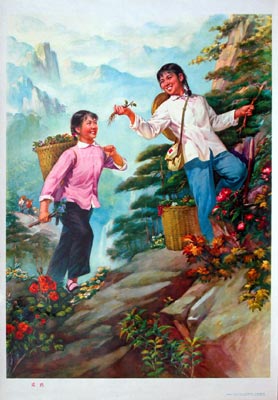
Wow. What a great collection of Chinese Revolutionary posters. 1,279 of them. I am partial to those featuring class warfare, tractor-driving, scientific/futuristic themes, and educational settings such as barefoot teachers in the fields. If you are a a Mac owner as well as a true red fanatic, you can get the Mac OS Maopost widget. (Right: collecting "medicinal" herbs.)


Defend yourselves against atomic, chemical and biological warfare.

Fang yuanzi, fang huaxue, fang xijun.

Tuesday, July 25, 2006

Chickenheads in Marketing

Harry Shearer reports on le show that KFC has appropriated a famous Daoist (a.k.a. Taoist) priest in an attempt to sell more chicken sandwiches. This disregards the famed vegetarianism of the Daoists and offended people across China. Don't these people think about running these ideas by a test audience, just to see how they react, before they go nationwide –to an audience of 1,300,000,000 people? China Daily is complaining, the story was reported in the Independent, and UPI has it, too.