Showing posts with label plants. Show all posts

Tuesday, August 23, 2011

Who moved my climate?

Climate warming accelerates Arctic migration for some species
http://www.alaskadispatch.com/article/climate-warming-accelerates-arctic-migration-some-species?page=full
"These changes are equivalent to animals and plants shifting away from the Equator at around 20 cm per hour,” added Thomas, Prof of Conservation Biology. “This has been going on for the last 40 years and is set to continue for at least the rest of this century.”
Call it the Goldilocks syndrome. Animals and plants are moving both higher in latitude and elevation much faster than previously thought in response to climate warming. They're chasing that "just right" sweet spot, but it keeps moving.

Rapid Range Shifts of Species Associated with High Levels of Climate Warming
http://www.sciencemag.org/content/333/6045/1024.abstract
The distributions of many terrestrial organisms are currently shifting in latitu...de or elevation in response to changing climate. Using a meta-analysis, we estimated that the distributions of species have recently shifted to higher elevations

Saturday, August 13, 2011

Sunflowers (Asahi Shimbun)


Sunflowers in full bloom in Kyoto
http://www.youtube.com/watch?v=_4TTHa50JGQ
About 150,000 sunflowers grown in resting rice fields are in full bloom in the town of Yosano, Kyoto Prefecture, attracting many tourists.

Tuesday, May 03, 2011

Real-world ecological half-life longer than expected

I think it's gonna be a long long time...
http://www.wired.com/wiredscience/2009/12/chernobyl-soil/

Reinhabiting the large exclusion zone around the accident site may have to wait longer than expected. Radioactive cesium isn’t disappearing from the environment as quickly as predicted, according to new research presented here Monday at the... meeting of the American Geophysical Union. Cesium 137’s half-life — the time it takes for half of a given amount of material to decay — is 30 years. In addition to that, cesium-137’s total ecological half-life — the time for half the cesium to disappear from the local environment through processes such as migration, weathering, and removal by organisms is also typically 30 years or less, but the amount of cesium in soil near Chernobyl isn’t decreasing nearly that fast. And scientists don’t know why.

It stands to reason that at some point the Ukrainian government would like to be able to use that land again, but the scientists have calculated that what they call cesium’s “ecological half-life” — the time for half the cesium to disappear from the local environment — is between 180 and 320 years.

“Normally you’d say that every 30 years, it’s half as bad as it was. But it’s not,” said Tim Jannik, nuclear scientist at Savannah River National Laboratory and a collaborator on the work. “It’s going to be longer before they repopulate the area.”
The original research pdf is existing here, written in the language English: http://sti.srs.gov/fulltext/SRNL-STI-2009-00770.pdf

Thursday, April 14, 2011

TEPCO 2.0


The PNG and the web edition (GIF).

Sunday, March 14, 2010

Ladybug and Lotus (though not at the same time or space)

Possible wallpapers, formatted to fit my display.


2009 photos taken with my phone. The ladybug was on the grassy hill overlooking Tokyo Bay down by the tetrapod beach at crematorium cove in Narashino in May. The lotuses were in Kyoto somewhere in a temple under some trees in a corner but I don't remember exactly.

Thursday, March 13, 2008

RotT2008

Revenge of the Trees 2008 is well underway. This year's cedar pollen levels are forecast to be three times higher than last year due to high temperatures last August(?). It seems to be off to a later start, however. I only appear in public now wearing a surgical mask, in order to prevent nasal congestion/nasal incontinence and continue breathing through my nose. Yesterday's wind-driven pollen was at an eye-burning, tear-inducing high for the season so far, even inside with the windows closed. A quick check of a local environmental agency pollen measuring site (at 東邦大学) shows levels shooting off the top of the scale at 2000 grains per cubic meter. I guess they will have to make a new scale. Again. I'm not sure if this year is going to be worse than 1995 and 2005, but I vaguely recall that 1000 was once the top of the scale and that 1995 broke records with levels around 1400.

Pollenitis was virtually unheard of until the 1970s. There seem to be two reasons why this is a major health irritant in modern Japan. Cedar trees were used for mass reforestation of clear-cut slopes after WW2, and slopes were planted in 100% cedar. That made the cedar pollen levels many times higher, but it also turns out that in close proximity, cedar trees seem to produce ten times more pollen to compete with other trees. The second contribution is sanitation. The lack of intestinal worms and unsanitary conditions of modern life seem to leave people with more highly-strung immune systems that overreact to a mass infusion of cedar pollen.

Silver lining: my medication makes me drowsy so I can close my eyes any time of day and fall asleep. Very convenient during commutes.

Wednesday, July 18, 2007

Popcorn Geomancy


We people-of-the-corn use corn in all of our important rituals, such as foretelling the future. Many popcorns in this batch were fused together, indicating either love, war, the collision of Earth with another planetoid, or the convergence of technology. The oddest one was this sword-wielding popcorn. The sword is of a decorative West Asian style, and the width of the blade indicates the large number of deaths in the coming conflagration. (Or it could be a ski.) Persia and Saudi Arabia are indicated. We can also see that many babies will be born with doglike mouths and double-rows of reptilian-like teeth, indicating the use of chemical, biological, or nuclear weapons, an impression strengthened by the appearance of skin boils. A war seems to last 8 to 10 years before attrition forces a settlement. A man with a sloping forehead and strange, powerful buttocks will be involved. Not sure who that is, as the creation of an Interpol Buttocks DataBase (IBDB) for the identification of bad guys has been a low priority, even with the lobbying efforts of Jim Baker. It's probably Putin or his successor, setting a trap for the Americans and British. Several ninja-like characters will be looking on, watching closely but staying extremely Swiss.

This is the popcorn talking, not me. I'd like nothing better than for the Bush administration to be slowly brought to justice and disempowered, if not necessarily disemboweled. I expect so, too. The popcorn says otherwise, that Iraq was just a warm-up, but that's just one popcorn talking, a minority report. Perhaps it has nothing to do with Bush but is a spontaneous explosion (in the smoldering post-traumatic geopolitical wreckage left by Bush). Each kernel represents an alternate future. The future is still unpopped. Consult your local maize for further information. The medium is the message.

By the way, if you still have the (soon-to-be) banned microwave variety, you should know that popcorn is a health hazard. (I have a supply that will last until winter). The volatile butter flavorings cause lung disease and the components of the bag migrate into the corn and are highly carcinogenic. It's not nice to fool Mother Nature. All those medical complications and it doesn't even get you high, well, not really. Try removing it from the bag and popping it in a well-ventilated area. Get a Fresnel lens and make solar popcorn to reduce your carbon gore-print.

Final prediction: popcorn will be found to contain neurotrophic proteins.

Sunday, July 09, 2006

The Final Report of Mr Higashi Take


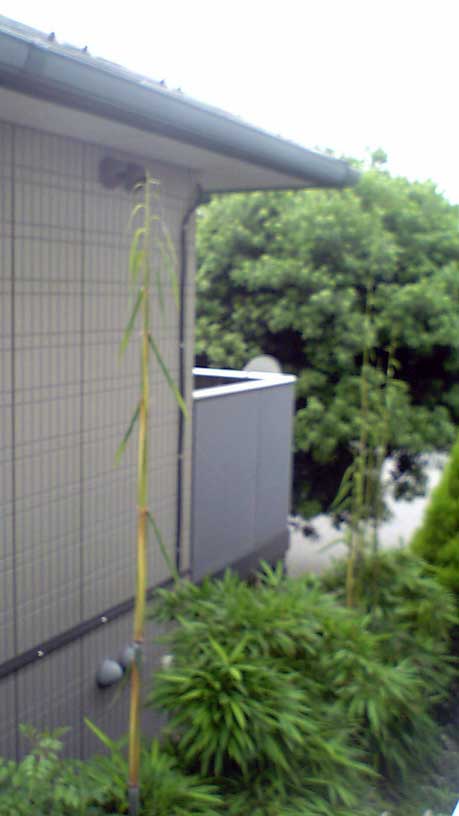
This particular bamboo appeared around June 15th (I didn't notice it for a while) and was 97 cm on the 18th. These are pictures of July 3rd, July 4th, and July 8th. As of July 8th, it has reached its full size (or so I hope) about a meter or more above the eaves of the sunshine-stealing steel apartment building next door. Calculating the height is perhaps my first opportunity to use the trig functions of sin, cos, and tan they went to so much work to teach us in high school. Unfortunately, I was unable to recover any memories of those traumatic experiences. Carrying on, I would estimate the height as probably 250 cm or a skosh more for each floor, 30 to 50 cm above the ground for the ground floor, and a meter on top of that. That's around 6 m or 650 cm in twenty-three days of growth. That comes to 28 cm a day, or more than a centimeter an hour, as I observed earlier. That's nearly a foot a day or just under an inch added every 2 hours, 24 hours a day, for this short bamboo sprouting season which is basically June.
There is a chance that in a typhoon it will blow around a lot and whack the hell out of those rain gutters, so if I don't want to take a chance and wait and see, I should snag it and cut off the top, making this the Final Report of Mr Take.

Tuesday, June 27, 2006

Tsuyu and Bamboo


How fast does bamboo grow? I measured this one at 250 cm on Saturday and 310 cm today, Tuesday. It's way too high to get in a photo and getting hard to measure now. Sixty centimeters in 3 days is about 20 centimenters a day, or an inch every 3 hours. Looking back farther at a few photos I took to document it, it was 97 cm on the 18th, making it 210 cm in 9 days, or close to 23 cm a day. This in a cloudy and cool rainy season (tsuyu) and a not-too-great location, so I would suppose some species of bamboo in better conditions grow about an inch an hour.
The four photos were taken 06-06-18_16:35, 24 hours later 06-06-19_16:27, another day later 06-06-20_16:25, and 06-06-24_09:19.
Bamboo is a gardener's dream, but also a nightmare. Your main task is to kill it faster than it can grow. This is best done during the crunchy asparagus/brocolli-like stage instead of the later ultralight-steel/aluminum-alloy-like woody stage, although you can still just saw through it when it gets hard. If you ignore it for a few days you will find the shoots, perhaps nearly as tall as yourself, sproating up all over, offshoots of the root network, really not unlike giant grassy asparagus. (Is the plural asparagi?) Bamboo shoots are good food, but I'm not eating these.
Speaking of words, Asparagus would be a good name for a boy. He would have an inferiority complex toward his brothers, Augustus and Julius, for their successful political and juice-vending careers. I suppose they could be members of the Grass, family, as I was about to mention that bamboo is a very large grass, not a tree or bush. The Grass family is a good name, certainly as good as Tree and better than Bush. Wouldn't you agree, Günter?

Sunday, June 18, 2006

Local Ethnobotanical Notes

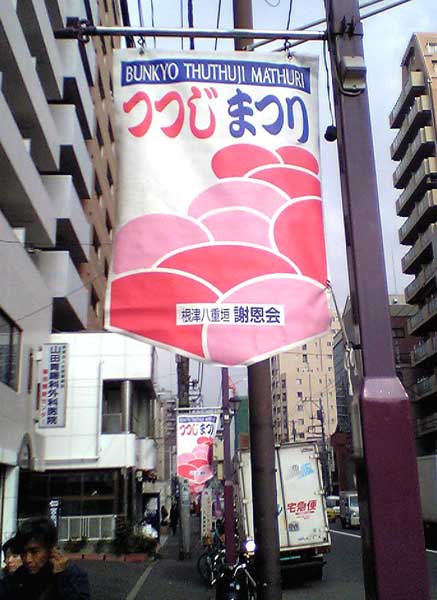
The tsutuji are long gone and the ajisai flower fadingly on as the take (bamboo) shoot up. I broke off a five foot high and four foot high bamboo in my garden yesterday, shoots that had appeared since Tuesday when I last checked for bamboo takeover attempts. The first ones appeared on May 31, a little early this year. They seem to grow about a foot or so a day; I'm not sure exactly, so I will try to document it more carefully this month. By the end of June they should be reaching the top of the second floor. They would completely take over my garden if I didn't patrol it mercilessly to save my trees and other plants. Bamboo are restricted to a narrow strip about 6 or 8 inches wide along my property line, where they enhance the fence effect.

Tsutsuji and ajisai are azalea and hydrangea, respectively, in English. Flowers and fish are two lexical domains in which my Japanese vocabulary is better than my English vocabulary. To enjoy a more professional visual documentation of Japanese flowers (and pottery, Buddhist sculpture and deities), visit http://www.onmarkproductions.com/index.html
by Mark Schumacher in Kamakura.