Proposed revision of the Russian Federation flag, inspired in part by the AK-47 on the Mozambique flag.
Monday, August 25, 2008
Russian Armored Vehicle Empire (RAVE)
Tags: art, democracy, Europe, human rights, politics, survival, symbolism, technology, violence, war, world
-
Blues Tea-Cha
-
8:52 PM
0
comments
Saturday, December 29, 2007
Waldseemüller Map
Tuesday December 4, 06:31 PMI don't understand how this map can be displayed in the Library of Congress and how the story can be reported on all the major news services worldwide (AAP, AFP, BBC, National Geographic) without someone (a reputable geographer, maybe?) offering an explanation to resolve the mystery. There are only a few good hypotheses that I can think of.
Map that named America is still a puzzle
The only surviving copy of the 500 year old map that first used the name America continues to be a puzzle for researchers.
The 1507 Waldseemuller map is due to go on permanent display this month at the Library of Congress in Washington DC.
Researchers want to know why the mapmaker named the territory America and then changed his mind, how he was able to draw South America so accurately and why did he put a huge ocean west of America years before European explorers discovered the Pacific?
"That's the kind of conundrum, the question, that is still out there," said John Hebert, chief of the geography and map division of the Library of Congress.
The 12 sheets that make up the map, purchased from German Prince Johannes Waldburg-Wolfegg for $US10 million ($A11.4 million) in 2003, have been mounted in a huge 1.85 metre by 2.95 metre display case machined from a single block of aluminum.
The case will be flooded with inert argon gas to prevent deterioration when it goes on public display on December 13.
Researchers are hopeful that putting the rarely shown map on permanent display for the first time since it was discovered in the Waldburg-Wolfegg castle archives in 1901 may stimulate interest in finding out more about the documents used to produce it.
The map was created by the German monk Martin Waldseemuller.
Thirteen years after Christopher Columbus first landed in the Western Hemisphere, the Duke of Lorraine brought Waldseemuller and a group of scholars together at a monastery in Saint-Die in France to create a new map of the world.
The result, published two years later, is stunningly accurate and surprisingly modern.
"The actual shape of South America is correct," said Hebert.
"The width of South America at certain key points is correct within 70 miles (100 km) of accuracy."
Given what Europeans are believed to have known about the world at the time, it should not have been possible for the mapmakers to produce it, he said.
The map gives a reasonably correct depiction of the west coast of South America. But according to history, Vasco Nunez de Balboa did not reach the Pacific by land until 1513, and Ferdinand Magellan did not round the southern tip of the continent until 1520.
"So this is a rather compelling map to say, 'How did they come to that conclusion,'" Hebert said.
The mapmakers say they based it on the 1,300-year-old works of the Egyptian geographer Ptolemy as well as letters Florentine navigator Amerigo Vespucci wrote describing his voyages to the new world. But Hebert said there must have been something more.
"From the writings of Vespucci you couldn't have prepared the map," Hebert said.
"There had to be something cartographic with it."
Waldseemuller made it clear he was naming the new land after Vespucci, describing how he came up with the name America based on the navigator's first name.
But he soon had misgivings about what he had done. An atlas Waldseemuller produced six years later shows only part of the east coast of the Americas, and refers to it as Terra Incognita - unknown land.
"America has gone out of his lexicon," Hebert said. "(No) place in the atlas - in the text or in the maps - does the name America appear."
His 1516 mariner's map, on the same scale as the 1507 map, steps back even further, showing only parts of the new continents and reconnecting the north to Asia. South America is labelled Terra Nova - New World - and North America is labelled Terra de Cuba - Land of Cuba.
"Essentially he's reconnecting North America to the Asian mainland, suggesting a continual world of land mass rather than separated by those bodies of water that separate us from Europe and Asia," Hebert said.
Why the rollback? No one knows.
- The map is a fraud and was not made at the date which is claimed for it. This seems unlikely if it has been decided to display it in the Library of Congress.
- The map used sources from the Aztecs, possibly a document which they had acquired from an earlier, higher (mathematically) civilization (Mayan or another lesser-known one). All but a handful of documents from the Aztecs have been destroyed, but we know they had universal male education, probably making them one of the most literate civilizations on the earth at that time, along with the Japanese.
- The map was produced from Egyptian sources. In this scenario, Columbus and other explorers may have had knowledge of the maps even before they went on their voyages, which were then undertaken to confirm the knowledge revealed from the long-lost Egyptian documents. Egypt had many different eras over the millennia of its existence, and cartography and navigation could have reached a high level during one of these periods, only to be subsequently lost in a famine-driven revolution and purge of the priestly/educated class.
- The map was reproduced from a map by a much earlier civilization from before the last ice age.
- Extraterrestrial input. The map was beyond human technology and came from a non-human intelligence.
The inability to explain this seems to be an ego problem. It is the same kind of arrogance that finds it incredible that chimps have better memory and visual skills than humans. Look, we are just hairless tail-less fire-monkeys. We have fire, mathematics, and language. For anything else there is probably another species that is better at it. I think Kurt Vonnegut said we were animals that did multiplication or something like that. Put another way, we have symbols and tools. Tools are extensions of our hands which birds, dolphins, and elephants were not so lucky to have. We do barn-raisings better than chimpanzees. Otherwise we are just a slightly more successful animal that has dominated the planet surface for 1% as long as the dinosaurs did.
Update 2008-02-11: The ultimate source of information about the Waldseemüller Map seems to be Library of Congress cartographer John Hessler, who maintains a blog on his research, WarpingHistory.
Thursday, March 08, 2007
Ghana and Covert Operations
Ghana became an independent country fifty years ago on March 6, 1957. Democracy Now dedicated a segment of the show to Ghanaian independence. Much of the segment was an interview with Gamal Nkrumah, son of Ghana's independence leader and first president, Kwame Nkrumah.
AMY GOODMAN: Gamal Nkrumah, how do you know that the CIA was behind the coup in Ghana?I was interested to know if there were, available on the internet, documents released under the Freedom of Information Act which implicated Papa Bush "41" in the CIA-assisted overthrow of Ghana's democracy, or if these documents had been "lost" or scrubbed during the rise to power of the monkey boy Bush.
GAMAL NKRUMAH: Well, it is no secret that George Bush, the father, was behind that particular project to topple Kwame Nkrumah. And surely enough, he was rewarded after the coup by being made director of the CIA, and his political career took off after that day. And the papers and documents of the time that were embargoed are now -- anybody can have access to those papers in Washington in the Library of Congress and read. Any serious student of history who’s interested in this particular episode would find ample evidence in those documents in Washington. It's available for all today.
I didn't find any direct evidence of it but some mostly undocumented mention of CIA involvement in sites such as wikipedia. This, however is an interesting article:
http://www.answers.com/topic/covert-operation-2
It explains Covert Operations from an academic, "value-free" point of view. I can't help but think it was written by a present or former spook, since it would be consistent with the psy ops it describes to control information in cyberspace, in this case by writing such an authoritative value-free article that it won't be easily supplanted a populist-leaning perspective and version of events.
Unlike many concepts in foreign affairs, the secret, sub rosa practice of covert operations has a formal definition officially approved by the president of the United States and embodied in a National Security Council (NSC) directive. According to NSC Directive 10/2, approved on 18 June 1948, a covert operation is an activity sponsored by the United States government against foreign states or groups that is so planned and executed that U.S. responsibility for it is not evident to an unauthorized person and that, if uncovered, the government can plausibly deny responsibility for the action. The operation could be unilateral, in support of a foreign state or group, and have a state or nonstate target—the key aspect is that the activity remain secret. Although not provided for in Directive 10/2, covert operations also can be conducted unilaterally or in conjunction with other friendly, or even adversary, intelligence services in pursuit of common objectives and goals.It's a well-written definition including plausible deniability, and the key concept of in conjunction with friendly (UK) or even adversary (Iran-Contra etc.) intelligence service.
Beneath the formal definition, the kinds of activity involved in covert operations fall into a number of broad categories. Chief among these are political action, paramilitary activity, psychological warfare, and economic warfare. The evolution of technology suggests strongly that operational incentives in intelligence work will shortly add a new broad category of cyberaction or computer warfare to the traditional covert action menu. A large-scale covert operation usually has components that involve many or all of these categories.OK, the four basic types. This is like attending CIA 101 at Langford. The bolds are mine, by the way. Go on.
In political action the object is to influence the internal situation in a foreign country by manipulating local political conditions. Intervention in an election is at the high end of the scale in political action, and might involve financial support for candidates, media advice, technical support for public relations, get-out-the-vote or political organizing efforts, legal expertise, advertising campaigns, assistance with poll-watching, and other means of direct action. … Mechanisms for creating and deepening opinions are of key importance in covert political action, which often therefore involves propaganda. Some of the earliest Central Intelligence Agency (CIA) covert operations were political actions to influence elections. …The CIA poured money into conservative groups like the JiMinTou in Japan after the war, and I am sure there were dozens of similar cases worldwide where American money gave conservatives a huge electoral advantage. Media advice through polling and other techniques help Latin American rightists fine-tune their message to punch the right buttons to sound acceptable. Technical support could mean getting all the equipment you need, legal expertise brings James Baker to mind, advertising is the forte of Karl Rove. Hey, aren't all of these applied domestically, for the control of the American people? Naturally, if you practice this overseas for a few years, you will logically come to use it at home. A few paragraphs later:
In paramilitary operations the intelligence service (or military force) conducts activities similar to those of constituted military units. Again the target may be a nation or a nonstate actor, but the currency of influence will be force. An operation may involve unconventional warfare, such as commando raids, training, advice, equipment, or command of irregular forces; it may also include support of guerrilla activities, creation of secret networks to oppose an adversary even if a country falls, the active propagation of a coup d'état, collaboration with or reinforcement of local security forces (such as the creation of a security detachment to protect a foreign head of state), and other functions. A number of U.S. paramilitary initiatives during the Cold War period involved cooperation with third country intelligence or military services.The toolbox is getting a heavier set of power tools with the paramilitary paragraph. Coup d'etat is such a successful and well-known instrument that has made America so popular in Iran, Latin America, and elsewhere. They even gave some thought to using it in Japan. Castro has been hard to get, but the Kennedys and civil rights leaders would have been sitting ducks. Irregular forces are death squads, contras, cult groups, neofascists, and terrorists. These people are also employed to run the CIA-affiliated private prisons worldwide in the basements of homes in wealthy neighborhoods! See this Washington Post article. Need I mention the support of Osama bin Laden? Failures as well as successes for the power-mad. Next, we get to the really good stuff, psy ops!
In psychological warfare the object is to mold opinion in the service of other activities, such as diplomacy, political action, paramilitary operations, or open warfare. Activities in psychological warfare run the gamut of the ways in which people absorb information. Traditionally, this has meant leaflets, newspapers, magazines, books, radio, and television, all of which have to be harnessed to convey the propaganda message appropriate to the operation. In the twenty-first century, techniques will expand to cover electronic communication by computer and the Internet as well, and intelligence services can create leaflets, finance books, journals, or television/radio programs. They may employ officers to work as journalists, recruit agents of influence, operate media outlets, plant certain stories or information in places it may come to public attention, or seek to deny and/or discredit information that is public knowledge. A distinction is made in psychological warfare regarding whether the target audience is permitted to be aware of the originator of the material they are receiving. In all such propaganda efforts, "black" operations denote those in which the audience is to be kept ignorant of the source; "white" efforts are those in which the originator openly acknowledges himself; and "gray" operations are those in which the source is partly but not fully acknowledged. In psychological warfare theory the attribution of a claim or piece of information included in a psychological warfare campaign has a bearing on the receptiveness of the audience, so that planners consider questions of black versus white carefully.CNN would be black, Fox would be white or gray in this description. The New York Times and Washington Times, Judy Miller, Bob Woodward, Rush Limbaugh and others could fit the bill. This category comes very close to "political" action earlier in the description. Media control is key. The Chinese are more advanced in managing the internet in a more totalitarian manner. The article goes on and many paragraphs later gets into Europe.
One of the first major U.S. covert operations was intervention in Italian politics in 1947–1948 to prevent an electoral victory by the Italian communist party. This political action started a lengthy involvement in Italy, which continued through at least the 1970s; it also set the standard for CIA political action programs. A similar intervention in France was designed to weaken the French communist party, while actions on the propaganda/psychological warfare front included funding journals and newspapers (the CIA would have a controlling interest in the Rome Daily American, for example), the Congress for Cultural Freedom, the World Assembly of Youth, the "gray" broadcast station Radio Free Europe, and the "black" (at least initially) station Radio Liberty. Both the CIA and OPC began programs to furnish financial support to publications and books deemed suitable for advancing the anticommunist cause, and money was laundered through the Marshall Plan and the Ford Foundation among others. Much of this knowledge emerged in a spate of revelations in 1967, forcing President Lyndon B. Johnson to appoint a special commission under deputy attorney general Nicolas de B. Katzenbach to investigate these political actions. One lesson that would be repeatedly relearned is that covert operations are fraught with political consequence for the initiator as well as the target.Here they basically admit the embarrassing public knowledge that NATO worked at funding and arming neo-fascist paramilitaries, cult groups, right-wing terrorists, and other secret societies in Europe to serve as "stay-behind armies" in case the Warsaw Pact ever overran the area. Gladio is the main word that is oddly never mentioned.
Paramilitary operations got under way in collaboration with the British Secret Intelligence Service (SIS). The Americans made a start in 1950–1952 by joining in an attempt to overthrow the communist government of Albania. The OPC, by this time, had lost its institutional independence and become part of the Directorate of Plans (DDP) within the CIA (in another 1952 reorganization the OPC and the directorate's other major unit, the espionage-centered Office of Special Operations, would be entirely merged) so that the actor on the American side of these operations was officially CIA. The CIA and SIS were allied in paramilitary operations into Russia (now Ukraine and Belarus), Estonia, Latvia, and Lithuania. Much of the burden in those operations was carried by the SIS, but in Poland, where there would be another combined paramilitary-political action, the CIA carried the burden. Every one of these operations was known to the adversary and had been penetrated by means of the Russians placing spies of their own within the CIA–SIS apparatus. All the operations failed by 1953. (However, it should be noted that anticommunist Russians continued efforts to make some kind of inroad into the USSR until at least the late 1950s.) The CIA moved on to greener pastures. The lesson here would be that covert operations against the communist enemy—the mandated target when the CIA created its covert operations program—were too difficult to carry out.
In general, operations proved most successful where the CIA had freedom of movement and good access, which in this period meant western Europe. A particular concern was the creation of stay-behind networks that would function just like the World War II resistance had in the event the Russians overran western Europe in a future war. Such nets were successfully created in virtually every western European country from Italy to Norway, including neutrals such as Sweden and even nations under military occupation like Austria. In some countries the secret networks were tied in to North Atlantic Treaty Organization (NATO) defense planning. In all of them the conservative political bent of adherents to the groups gave the CIA certain political contacts. Secrecy lasted for several decades, until a rash of detailed revelations during the early 1980s led to controversy, with parliamentary inquiries in more than one European country and attendant embarrassment for the United States. The lesson here contradicts an aphorism often heard from intelligence officers, that successes remain secret while only failures become known to the public. More accurately, every covert operation above a certain size will ultimately become known.
It would be during the early 1950s that the CIA's Directorate of Plans achieved its classic covert victories. One came in Iran in 1953 in conjunction with SIS, where the Americans and British induced an unusual coup in which a constitutional monarch overthrew the government of his own country. Here the shah of Iran, relying upon popular support of the CIA, had mobilized and ousted a left-wing populist cabinet to create a virtual military dictatorship. In another victory in 1954, the CIA overthrew the elected Labor Party (socialist to communist ideologically) government of Guatemala, through a combination of psychological warfare, paramilitary action by a small force, and diplomatic pressure. Again the successor government was a military dictatorship.The overthrow of democracy in Iran and Guatemala are pointed to as classic successes? That, and the "lessons learned" at the end of each paragraph, which are always what the perpetrators themselves learned, makes this really appear to be text generated as some kind of required reading for US spooks. How can the overthrow of Iranian democracy resulting first in an oppressor, torture-based regime, and then in a theocratic terrorist-supporting government be the most classic example of the success of American covert intervention?
The shah of Iran managed to hold on to power through the late 1970s by a combination of economic modernization and political repression, but the suppression of moderate political forces in his country forced opposition to align with a fundamentalist religious movement that ultimately toppled the shah in a 1979 revolution. At that time the U.S. embassy would be taken over, and American diplomats (and the officers of the CIA station) held hostage for 444 days, with the United States painted as the "Great Satan" to the Iranian public. In the years since the Iranian revolution, the United States was unable to restore a balanced relationship with Iran. Worse, the Iranians supported terrorist groups in the Middle East through the 1980s, which significantly harmed American interests and took lives, hostages, and made other depredations in a succession of incidents.
In Guatemala the military government installed by the covert operation replaced a democratic tradition and handed power to other military regimes or authoritarian oligarchies that maintained authority by high security. Beginning in 1968 the military inaugurated a war against the peasantry that endured into the late 1990s, leaving more than half the population of the country displaced internally and with a death toll in excess of 60,000.
A lesson here is that covert operations successes do not always lead to achievements to be proud of, possibly due to the moral, political, and empirical compromises necessary in pursuit of the short-term action. In addition, long-term effects can be more detrimental to U.S. interests than the improvements gained by the original success.
The article has sections dedicated to the evolution of covert activities under various presidents, congresses, and changes. For Johnson:
The Johnson administration ended the covert operation against Cuba and phased out CIA action in the Congo. However, it encouraged a coup in Ghana and brought major intelligence resources to bear in Bolivia against Che Guevara, a hero of the Cuban revolution. In Chile the Johnson administration carried out a political action during the 1964 elections to prevent any victory by Chilean socialists. In Asia, the Johnson-era CIA terminated the Tibetan paramilitary operation, attempted a political action in Indonesia (1965–1966), and carried out full-scale secret wars in Laos and South Vietnam. Johnson also continued CIA funding for Radio Free Europe and Radio Liberty's "gray" psychological warfare campaign.That is the only mention of Ghana in that document. An interesting article nonetheless.
Another article sourced from answers.com with a less spook-y writing style was the one I found here: http://www.answers.com/topic/central-intelligence-agency
During the Cold War, the primary target of the CIA was, of course, the Soviet Union. Despite the closed nature of Soviet society and the size and intensity of the KGB's counterintelligence operation, the CIA had a number of notable successes. The most significant was Colonel Oleg Penkovskiy, a Soviet military intelligence (GRU) officer. In 1961 and 1962, Penkovskiy passed great quantities of material to the CIA and the British Secret Intelligence Service, including information on Soviet strategic capabilities and nuclear targeting policy. In addition, he provided a copy of the official Soviet medium-range ballistic missile manual, which was of crucial importance at the time of the Cuban missile crisis.No mention of Papa Bush being in on the (covert) action.
In subsequent years, the CIA penetrated the Soviet Foreign Ministry, Defense Ministry and General Staff, GRU, KGB, at least one military research facility, and probably several other Soviet organizations. Individuals providing data to the CIA included some stationed in the Soviet Union, some in Soviet consulates and embassies, and some assigned to the United Nations or other international organizations. CIA HUMINT operations successfully penetrated a number of other foreign governments during the last half of the twentieth century, including India, Israel, the People's Republic of China, Taiwan, the Philippines, and Ghana.
American tax dollars at work, making the world safe for theocracy. It's hard work.
Tags: 'Nesia, Asia, books, democracy, Earth, elections, Europe, freedom, history, human rights, intolerance, mind, NiHon, numbers, politics, Republic of Armed Desire, Republika ng Pilipinas, United States, violence, war
-
Blues Tea-Cha
-
10:15 AM
0
comments
Saturday, March 03, 2007
US-backed post-war fascism on 3 continents
Last week Dick Cheney refused to meet with Japanese Defense Minister Kyuma. Japan has sent troops to Iraq (they finished their mission successfully) and brought them home, but Kyuma was just not Right enough for Cheney.
That information took on a different meaning this week with the news that the US CIA considered a coup de etat against pro-American Prime Minister Shigeru Yoshida in 1952. It seems he just wasn't right enough for the anti-communists who the US was strengthening as cold war fodder.
Find the story at:By JOSEPH COLEMANThe Associated PressDeclassified documents reveal that Japanese ultranationalists with ties to U.S. military intelligence plotted to overthrow the Japanese government and assassinate the prime minister in 1952.
The scheme -- which was abandoned -- was concocted by militarists and suspected war criminals who had worked for U.S. Occupation authorities after World War II, according to CIA records reviewed by AP. The plotters wanted a rightwing government that would rearm Japan.
The CIA files, declassified in 2005 and publicized by the U.S. National Archives in January, detail a plot to oust the pro-U.S. prime minister, Shigeru Yoshida, and install a more hawkish government led by Ichiro Hatoyama.
The CIA, in papers released under an act of Congress to declassify documents related to Japanese war crimes, said the plotters were led by Takushiro Hattori, a former private secretary to Gen. Hideki Tojo, the wartime prime minister hanged for war crimes in 1948.
Two CIA documents said the plot reportedly had the support of 500,000 people in Japan, and that the group planned to use a contact who controlled a faction inside the National Safety Agency -- a precursor to the Defense Ministry -- to help launch the coup.
The files reviewed by the AP strongly suggest the Americans were unaware of the plot until after it had been dropped. The plot was developed after the Occupation ended in April 1952, and the CIA files say American financial support for Hattori's group had dried up by then.
Still, the documentary evidence of the plot illustrates the violent potential of the rightwing, anticommunist cabal that had worked under the Occupation authority's G-2 intelligence wing in the early days of the Cold War in the late 1940s and early 50s. The CIA operated separately from G-2.
"Since the beginning of July 1952, plans for a coup d'etat have been initiated among a group of ex-purgees, including former military officers. The leader of the group is ex-Col. Hattori Takushiro," said an Oct. 31, 1952, report, which claimed, "this report is the first to mention a definite rightist plan involving violence.
"The original plan of the group was to engineer a coup d'etat, including the assassination of Prime Minister Yoshida Shigeru on account of his hostile attitude toward depurgees and nationalists," the CIA document said.
According to the document, Hattori colleague Masanobu Tsuji talked the group out of the coup, urging it to focus instead on countering the Socialist Party. The files say the group then decided it would not stage a coup as long as Yoshida's conservative Liberal Party remained in power.
However, the group still considered violence an option, the files say.
"The group is considering the possibility of some minor assassination attempt in lieu of a coup d'etat," the Oct. 31, 1952, document said.
Hattori and others had worked under the aegis of Maj. Gen. Charles Willoughby, the anticommunist G-2 chief. During the Occupation, Willoughby was considered the second-most powerful American after his boss, Gen. Douglas MacArthur.
Some group members were considered choice war crimes trial targets after the war.
Tsuji had been wanted for involvement in the Bataan Death March of 1942, in which thousands of Americans and Filipinos perished. Another group associate was Yoshio Kodama, a war profiteer and mob boss who was deeply involved in procuring materials -- often illegally -- for the Japanese military machine.
Neither of them was prosecuted for war crimes.
The Japanese militarists joined U.S.-supported missions to spy on communists in Japan, infiltrate agents into Soviet and North Korean territory, and recruit Japanese mercenaries to protect Taiwan from communist forces in mainland China, declassified documents show.
The CIA files, however, say the operations were riddled with intelligence leaks, hobbled by a lack of competent agents, and deeply compromised by rivalries among the rightists themselves. The agents' priorities, the documents say, were profits and an eventual resurgence of a militarist Japan.
The assassination plot detailed in the CIA files came at a difficult time for Hattori's group.
The departure of Willoughby from Japan in 1951 as the Occupation wound down deprived the rightists of their leading American patron and paymaster. Meanwhile, Yoshida was openly hostile to Hattori's push for rearmament.
"The government attitude toward the Hattori group has been increasingly antagonistic, and the group has lost influence since the departure of Gen. Willoughby," said a CIA document dated April 18, 1952.
Yoshida was pushed out of office peacefully in 1954 and replaced by Hatoyama, but the ultrarightist dream of resurrecting a militarist Japan never happened. The 1947 Constitution bars Japan from warfare and has never been amended.
http://search.japantimes.co.jp/cgi-bin/nn20070306f3.html
http://www.chinadaily.com.cn/world/2007-03/01/content_816614.htm
This could have caused Japan to have a completely different history of coups, renewed militarism, multiple constitutions. I imagine it developing more like the post-war Philippines or South Korea. By now it would probably be a nuclear-armed anti-American economic basket-case. But who knows.
We almost had a coup in the United States during the FDR administration, courtesy of admirers and financers of Hitler such as Prescott Bush (Monkey Boy King's Grandfather).
http://www.dailykos.com/story/2005/2/27/112936/440
And in the course of researching something else, I found out about NATO "stay-behind" operations such as Operation Gladio, which funded a secret army of far-right wing parties, neofascist terrorists, paramilitaries, and cult groups in Europe.
I recall the Nixon-era saying, "Just because I'm paranoid doesn't mean they're not out to get me." It's a depressing thought, but I wonder if I'm really not paranoid enough to imagine all of the perverse crap going on behind the scenes.
Tags: Earth, Europe, politics, Republika ng Pilipinas, survival, United States, violence, war
-
Blues Tea-Cha
-
4:26 PM
0
comments
Sunday, July 09, 2006
Christianity's Gay Cultural Heritage
I have sometimes argued that while there is plenty of historical evidence of polygamy and polygyny, there is no history of gay marriage, and that rather than making it socially recognized when half of society is not ready to recognize it, we should instead abolish any connection or recognition of marriage by government. Individuals should be free to have whatever religious ceremonies they want, and enter into any contractual obligations with others within certain broad guidelines (e.g. no slavery) without any interest, involvement, or interference by the secular government. There should not be a one-size-fits-all marriage contractual conditions specified by each state or by the national government.
Well, it turns out I was wrong about the historical evidence of gay marriage. How did that happen? I must have missed school on the day we did gay studies. The Irish Times published an article on it so long ago, 1998, that I will briefly quote it in its entirety here:
When marriage between gays was by riteThat's mind-blowing. I don't know if that changes my view on making it legal nationwide. There may be some other issues involved, and I haven't really researched it. For example, I think there may be even just as many gay sham marriages and mail-order brides as there were heterosexual ones.
Tuesday, August 11, 1998
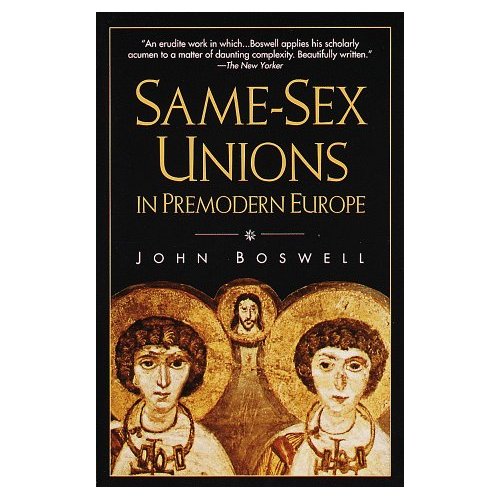
RITE AND REASON: A Kiev art museum contains a curious icon from St Catherine's monastery on Mount Sinai. It shows two robed Christian saints. Between them is a traditional Roman pronubus (best man) overseeing what in a standard Roman icon would be the wedding of a husband and wife. In the icon, Christ is the pronubus. Only one thing is unusual. The "husband and wife" are in fact two men.
Is the icon suggesting that a homosexual "marriage" is one sanctified by Christ? The very idea initially seems shocking. The full answer comes from other sources about the two men featured, St Serge and St Bacchus, two Roman soldiers who became Christian martyrs.
While the pairing of saints, particularly in the early Church, was not unusual, the association of these two men was regarded as particularly close. Severus of Antioch in the sixth century explained that "we should not separate in speech [Serge and Bacchus] who were joined in life". More bluntly, in the definitive 10th century Greek account of their lives, St Serge is openly described as the "sweet companion and lover" of St Bacchus.
In other words, it confirms what the earlier icon implies, that they were a homosexual couple. Unusually their orientation and relationship was openly accepted by early Christian writers. Furthermore, in an image that to some modern Christian eyes might border on blasphemy, the icon has Christ himself as their pronubus, their best man overseeing their "marriage".
The very idea of a Christian homosexual marriage seems incredible. Yet after a 12-year search of Catholic and Orthodox church archives Yale history professor John Boswell has discovered that a type of Christian homosexual "marriage" did exist as late as the 18th century.
Contrary to myth, Christianity's concept of marriage has not been set in stone since the days of Christ, but has evolved both as a concept and as a ritual. Prof Boswell discovered that in addition to heterosexual marriage ceremonies in ancient church liturgical documents (and clearly separate from other types of non-marital blessings such as blessings of adopted children or land) were ceremonies called, among other titles, the "Office of Same Sex Union" (10th and 11th century Greek) or the "Order for Uniting Two Men" (11th and 12th century).
These ceremonies had all the contemporary symbols of a marriage: a community gathered in church, a blessing of the couple before the altar, their right hands joined as at heterosexual marriages, the participation of a priest, the taking of the Eucharist, a wedding banquet aftet afterwards. All of which are shown in contemporary drawings of the same sex union of Byzantine Emperor Basil I (867-886) and his companion John. Such homosexual unions also took place in Ireland in the late 12th/early 13th century, as the chronicler Gerald of Wales (Geraldus Cambrensis) has recorded.
Boswell's book, The Marriage of Likeness: Same Sex Unions in Pre- Modern Europe, lists in detail some same sex union ceremonies found in ancient church liturgical documents. One Greek 13th century "Order for Solemnisation of Same Sex Union" having invoked St Serge and St Bacchus, called on God to "vouchsafe unto these thy servants [N and N] grace to love one another and to abide unhated and not a cause of scandal all the days of their lives, with the help of the Holy Mother of God and all thy saints." The ceremony concludes: "And they shall kiss the Holy Gospel and each other, and it shall be concluded."
Another 14th century Serbian Slavonic "Office of Same Sex Union", uniting two men or two women, had the couple having their right hands laid on the Gospel while having a cross placed in their left hands. Having kissed the Gospel, the couple were then required to kiss each other, after which the priest, having raised up the Eucharist, would give them both communion.
Boswell found records of same-sex unions in such diverse archives as those in the Vatican, in St Petersburg, in Paris, Istanbul, and in Sinai, covering ering a period from the 8th to the 18th centuries. Nor is he the first to make such a discovery. The Dominican Jacques Goar (1601-1653) includes such ceremonies in a printed collection of Greek prayer books.
While homosexuality was technically illegal from late Roman times, it was only from about the 14th century that anti-homosexual feelings swept western Europe. Yet same sex union ceremonies continued to take place.
At St John Lateran in Rome (traditionally the Pope's parish Church) in 1578 as many as 13 couples were "married" at Mass with the apparent co-operation of the local clergy, "taking Communion together, using the same nuptial Scripture, after which they slept and ate together", according to a contemporary report.
Another woman-to-woman union is recorded in Dalmatia in the 18th century. Many questionable historical claims about the church have been made by some recent writers in this newspaper.
Boswell's academic study however is so well researched and sourced as to pose fundamental questions for both modern church leaders and heterosexual Christians about their attitude towards homosexuality.
FOR the Church to ignore the evidence in its own archives would be a cowardly cop-out. That evidence shows convincingly that what the modern church claims has been its constant unchanging attitude towards homosexuality is in fact nothing of the sort.
It proves that for much of the last two millennia, illennia, in parish churches and cathedrals throughout Christendom from Ireland to Istanbul and in the heart of Rome itself, homosexual relationships were accepted as valid expressions of a God-given ability to love and commit to another person, a love that could be celebrated, honoured and blessed both in the name of, and through the Eucharist in the presence of Jesus Christ.
Jim Duffy is a writer and historian. The Marriage of Likeness: Same Sex Unions in Pre-Modern Europe by John Boswell is published by Harper Collins.
Here is the book the article references, on Amazon. Oops, it's the UK Amazon, but appropriately so, perhaps. Indeed, the UK Amazon has a Special Relationship with the US one.
Is there anything more gay than Christianity? SpongeBob!?
In a (sorta) related story, James Dobson, founder of Focus on the Family, claimed in 2005 that SpongeBob SquarePants, Barney, and Jimmy Neutron, among many others, appear in a "pro-homosexual video," that its makers planned to mail to thousands of elementary schools. Little did Mr Dobson, or I know, that Mr. S.B. SquarePants was presumably promoting recognition and respect for a long-recognized Christian rite of the European civilizations.