Showing posts with label physics. Show all posts

Sunday, April 29, 2012

Breaking down the environmental radioactivity monitoring data from MEXT (Ministry of Education, Culture, Sports, Science and Technology and whatnot)

As reported in the Asahi:

The science ministry has begun posting real-time radiation levels on its website at 2,700 locations across Fukushima Prefecture, including schools and parks.
To access radiation levels measured at 10-minute intervals, go to http://radiomap.mext.go.jp/ja/.
http://ajw.asahi.com/article/behind_news/social_affairs/AJ201202220028

A picture of the equipment:
https://dwqovw6qi0vie.cloudfront.net/article-imgs/en/2012/02/22/AJ201202220028/AJ201202220029M.jpg

Checking out today's data at
http://radioactivity.mext.go.jp/map/ja/area.html

Let's do some math...

Consider the maximum acceptable radiation dose for the public from any man-made facility: 1 mSv/year.
1 mSv/year is 1000 μSv/year.
1000 μSv/year is 0.114 μSv/h.
(Based on 8766 hours in a year (24×365.25) and 1000 microsieverts(μSv) in a millisievert (mSv).
Therefore any place with over 0.114 μSv/h is questionable.

Japan set a limit 20 times higher, 20mSv/year, for Fukushima residents.

Residents exposed at that level would reach the 350 mSv/lifetime limit which was used to determine evacuation areas after the Chernobyl disaster within 18 years.
Using the Chernobyl lifetime standard, calculating for a 10-year old child with an additional 70 years life expectancy, 350mSv/70years = 5mSv/year.

Recapping, the 1 mSv/year international standard is exceeded by the Chernobyl evacuation standard, which (if judged to be tolerable) could conceivably justify 5 mSv/year for kids (twice that for 35-year-olds, etc.), and that was exceeded by the 20 mSv/year Japanese Fukushima-only standard, which I believe was set at that level for political reasons only, to set a standard that would avoid the need to evacuate several large cities and partially sever northern Japan from the south and middle.

Some selected ranges of readings for locations today, Sunday, April 29, 2012:

Fukushima-ken locations:
MinamiSoma     0.080 - 5.036 μSv/h = 0.701 - 44.14 mSv/year
Fukushima City     0.092 - 1.764 μSv/h = 0.806 - 15.46 mSv/year
NihonMatsu     0.113 - 1.324 μSv/h = 0.990 - 11.60 mSv/year
Koriyama     0.067 - 1.379 μSv/h = 0.587 - 12.08 mSv/year
Sukagawa City     0.098 - 0.727 μSv/h = 0.859 - 6.372 mSv/year
Soma City     0.093 - 1.125 μSv/h = 0.815 - 9.862 mSv/year
Iwaki City     0.054 - 0.819 μSv/h = 0.473 - 7.179 mSv/year
Aizu-Wakamatsu     0.054 - 0.290 μSv/h = 0.473 - 2.542 mSv/year

Outside Fukushima-ken:
Tochigi-ken     0.036 - 0.593 μSv/h = 0.315 - 5.198 mSv/year
Miyagi-ken     0.033 - 0.367 μSv/h = 0.289 - 3.217 mSv/year
Ibaraki-ken     0.048 - 0.178 μSv/h = 0.420 - 1.560 mSv/year
Chiba-ken     0.037 - 0.172 μSv/h = 0.324 - 1.507 mSv/year
Gunma-ken     0.026 - 0.154 μSv/h = 0.228 - 1.349 mSv/year
Saitama-ken     0.027 - 0.154 μSv/h = 0.236 - 1.349 mSv/year
Tokyo-to     0.037 - 0.064 μSv/h = 0.324 - 0.561 mSv/year

If you use the lifetime-exposure evacuation standard for Chernobyl applied to children, all children should be evacuated from all of the cities measured in eastern Fukushima prefecture, with the exception of Aizu-Wakamatsu, which is more central, but which still exceeds the 1 mSv/year international standard for the nuclear power industry. Some sites in Tochigi prefecture also exceed the Chernobyl standard and should evacuate children.

All of these prefectures in the Kanto region have at least a few MEXT radiation measurement stations (which are very limited in number outside Fukushima, by the way, 5 stations in Tokyo, 7 in Chiba, etc) which record levels above the 1 mSv/year international standard. By that standard, Kanto is barely tolerable.

Numbers here in Chiba:
html at http://radioactivity.mext.go.jp/html/12/12000.html
2012年04月29日 20時00分時点

  • 市原市 県環境研究センター  0.037μSv/h


  • 柏市 市立田中小学校  0.116μSv/h
  • 印西市 市立船穂中学校  0.170μSv/h
  • 香取市 香取市役所小見川区事務所  0.082μSv/h
  • 市川市 市立大柏小学校  0.104μSv/h
  • 館山市 県安房農業普及センター跡地  0.059μSv/h
  • 茂原市 県大気汚染常時監視測定局  0.051μSv/h


  • In Chiba, Kashiwa (柏市) and Inzai (印西市) both exceed the 1 milliSievert/year limit for added radiation from nuclear power.

    Friday, April 20, 2012

    Wednesday, April 18, 2012

    Nuclear Titanics

    http://www.counterpunch.org/2012/04/16/nuclear-titanics/

    ▶ April 16, 2012
    The Perils of Technological Hubris
    Nuclear Titanics
    by KARL GROSSMAN

    On the 100th anniversary of the sinking of the Titanic, The Japan Times yesterday ran an editorial titled “The Titanic and the Nuclear Fiasco” which stated: “Presenting technology as completely safe, trustworthy or miraculous may seem to be a thing of the past, but the parallels between the Titanic and Japan’s nuclear power industry could not be clearer.”

    “Japan’s nuclear power plants were, like the Titanic, advertised as marvels of modern science that were completely safe. Certain technologies, whether they promise to float a luxury liner or provide clean energy, can never be made entirely safe,” it said.

    It quoted from a piece by Joseph Conrad written after the Titanic sank in which he noted the “chastening influence it should have on the self-confidence of mankind.” The Japan Times urged: “That lesson should be applied to all ‘unsinkable’ undertakings that might profit a few by imperiling the majority of others.”
    http://www.japantimes.co.jp/text/ed20120415a1.html

    Read the whole article. 

    Monday, April 16, 2012

    11,000 fuel rods, 85×Chernobyl at Fukushima Dai-Ichi site

    Sometimes i worry.
    A potential 85 × Chernobyls worth of radioactivity on-site in 11,000 spent fuel rods, parts of the site already too radioactive for humans or robots to approach, spent fuel pools suspended 30 meters in the air requiring constant cooling, structurally unsound. Only one spent fuel pool or reactor needs to go kablooey to make the site uninhabitable, at which point we can only retreat and try to deal with it from afar, perhaps with fly-overs like in Chernobyl. Even their best-case scenarios call for developing technology to try to clean up the site in 40 years or so, more likely not in centuries.

    http://akiomatsumura.com/2012/04/682.html

    Japan’s former Ambassador to Switzerland, Mr. Mitsuhei Murata, was invited to speak at the Public Hearing of the Budgetary Committee of the House of Councilors on March 22, 2012, on the Fukushima nuclear power plants accident. Before the Committee, Ambassador Murata strongly stated that if the crippled building of reactor unit 4—with 1,535 fuel rods in the spent fuel pool 100 feet (30 meters) above the ground—collapses, not only will it cause a shutdown of all six reactors but will also affect the common spent fuel pool containing 6,375 fuel rods, located some 50 meters from reactor 4. In both cases the radioactive rods are not protected by a containment vessel; dangerously, they are open to the air. This would certainly cause a global catastrophe like we have never before experienced. He stressed that the responsibility of Japan to the rest of the world is immeasurable. Such a catastrophe would affect us all for centuries. Ambassador Murata informed us that the total numbers of the spent fuel rods at the Fukushima Daiichi site excluding the rods in the pressure vessel is 11,421 (396+615+566+1,535+994+940+6375).

    I asked top spent-fuel pools expert Mr. Robert Alvarez, former Senior Policy Adviser to the Secretary and Deputy Assistant Secretary for National Security and the Environment at the U.S. Department of Energy, for an explanation of the potential impact of the 11,421 rods.

    I received an astounding response from Mr. Alvarez [updated 4/5/12]:
    "In recent times, more information about the spent fuel situation at the Fukushima-Dai-Ichi site has become known. It is my understanding that of the 1,532 spent fuel assemblies in reactor No. 304 assemblies are fresh and unirradiated. This then leaves 1,231 irradiated spent fuel rods in pool No. 4, which contain roughly 37 million curies (~1.4E+18 Becquerel) of long-lived radioactivity. The No. 4 pool is about 100 feet above ground, is structurally damaged and is exposed to the open elements. If an earthquake or other event were to cause this pool to drain this could result in a catastrophic radiological fire involving nearly 10 times the amount of Cs-137 released by the Chernobyl accident.
    The infrastructure to safely remove this material was destroyed as it was at the other three reactors. Spent reactor fuel cannot be simply lifted into the air by a crane as if it were routine cargo. In order to prevent severe radiation exposures, fires and possible explosions, it must be transferred at all times in water and heavily shielded structures into dry casks.. As this has never been done before, the removal of the spent fuel from the pools at the damaged Fukushima-Dai-Ichi reactors will require a major and time-consuming re-construction effort and will be charting in unknown waters. Despite the enormous destruction cased at the Da–Ichi site, dry casks holding a smaller amount of spent fuel appear to be unscathed."

    Based on U.S. Energy Department data, assuming a total of 11,138 spent fuel assemblies are being stored at the Dai-Ichi site, nearly all, which is in pools. They contain roughly 336 million curies (~1.2 E+19 Bq) of long-lived radioactivity. About 134 million curies is Cesium-137 — roughly 85 times the amount of Cs-137 released at the Chernobyl accident as estimated by the U.S. National Council on Radiation Protection (NCRP). The total spent reactor fuel inventory at the Fukushima-Daichi site contains nearly half of the total amount of Cs-137 estimated by the NCRP to have been released by all atmospheric nuclear weapons testing, Chernobyl, and world-wide reprocessing plants (~270 million curies or ~9.9 E+18 Becquerel).

    It is important for the public to understand that reactors that have been operating for decades, such as those at the Fukushima-Dai-Ichi site have generated some of the largest concentrations of radioactivity on the planet. "

    Many of our readers might find it difficult to appreciate the actual meaning of the figure, yet we can grasp what 85 times more Cesium-137 than the Chernobyl would mean. It would destroy the world environment and our civilization. This is not rocket science, nor does it connect to the pugilistic debate over nuclear power plants. This is an issue of human survival.

    Monday, April 02, 2012

    The Naoto Matsumura Experience (Take a walk on the wild side)

    https://www.youtube.com/watch?v=pOvLIf39xO0

    I respect his decision to live free, but i think his call to decontaminate such a large area is hopeless and wasted effort. Time will deal with it. People should leave. Farmers should be compensated with new farms elsewhere, as the population is falling and the countryside is being abandoned. Then they can farm without compromised produce or stigma. (As it is now, the government buys contaminated rice grown anywhere outside the prohibited zone and charges TEPCO, so all consumers pay the cost of continued attempts to farm in Fukushima prefecture.) Contaminated soil should be covered with less contaminated soil brought in from elsewhere. Cover 120μSv/hr soil with 37μSv/hr soil brought in from less contaminated areas, and so on. 

    Hamaoka, the world's most dangerous nuclear power plant

    https://ssl.panoramio.com/photo/45405527 I cycled near it once on this Pacific Tokai Cycling Road (but that's not my picture).

    http://www.csmonitor.com/World/Asia-Pacific/2012/0310/Japan-s-Hamaoka-nuclear-plant-sees-tsunami-defense-in-very-big-wall This article from a few weeks ago has been superceded by new estimates of a magnitude 9 quake and a 30-meter wave. Hopefully it will never reopen.
    Japan's controversial Hamaoka nuclear plant, shut down after Fukushima, wants to reopen once a 54-ft.-high, mile-long wall is finished. But the plant also sits on a seismic fault line, raising more than a few doubts.
     WSJ, 2011 http://blogs.wsj.com/japanrealtime/2011/05/06/hamaoka-japans-most-infamous-nuclear-plant/
    Since a tsunami wrecked the Fukushima Daiichi nuclear power plant a year ago, leading to meltdown in three of its reactors, all eyes in Japan have been on the Hamaoka plant, 300 miles down the coast and similarly located right on the seashore. It has been branded the most dangerous nuclear power station in the world by some seismologists.

    Its operator, Chubu Electric, is determined to reopen the plant as soon as its workers have finished building a six-ft.-thick anti-tsunami wall that will stand 54 feet above sea level and stretch a mile; the manmade hills now being constructed are a first step in the yearlong project.

    But many local residents are not so sure.

    “I was always a little worried before last March,” says Fumio Takahashi, a real estate agent who lives in the town of Omaezaki, hard by the Hamaoka plant. “Now I realize that it is dangerous to have a nuclear plant near your home. I absolutely do not want it to reopen.”

    Hamaoka is particularly dangerous, explains Yoshika Shiratori, because it is built on a seismic fault line where Japanese government experts have estimated that there is an 87 percent chance of a magnitude 8 earthquake within the next 30 years.

    Hamaoka Nuclear Power Station Exhibition Center video

    Hamaoka Nuclear Power Station Exhibition Center has a scale model of an actual nuclear reactor, the walls, fuel rods, assemblies, containments, etc so you can get a feel for it. https://www.youtube.com/watch?v=RgMaAFdkm5Q


    Video #1
    saves you going all the way to Shizuoka
    2011-05-02-13:40 status: monitoring radioactive iodine.
    Units 4 and 5 (boiling water reactors) were still in operation on that day!


     Video #2. My compliments to the videographer! Thanks, dude! Good job!


    ‎#3 gets opinionated at 8:30 and includes the PM's order to close the plant on May 6.

    Tuesday, March 27, 2012

    Lightning and Neutrons

    http://arstechnica.com/science/news/2012/03/nuclear-lightening.ars

    -: inexplicata of the day :-
    Lightning strikes produce free neutrons, and we're not sure how
    Scientists confirm that lightning strikes generate low energy neutrons, but eliminate both of the explanations we had for how this might work.
    http://dx.doi.org/10.1103/PhysRevLett.108.125001

    Tuesday, March 13, 2012

    One Spent Fuel Pool Has More Radioactive Cesium-137 Than Every Nuclear Bomb Ever Exploded In The Atmosphere

    Nuclear Engineer Arnie Gundersen: Fukushima Meltdown Could Result in 1 Million Cases of Cancer

    The Obama administration is backing an expansion of nuclear power plants, but…

    "I’m on record as saying that we should close the 23 reactors with the Mark I design. … These containment vents prove to fail three times out of three. …

    In addition, the fuel is stored on the roof, essentially, in unshielded, unprotected areas. And there’s more nuclear cesium-137 in the fuel pool at the plant in Pilgrim, Massachusetts, than was ever released by every nuclear bomb ever exploded in the atmosphere. So we have an enormous inventory of nuclear material way up on the roofs of these buildings, and I think it’s time to close these Mark 1s down, because of those two design features."
    https://www.democracynow.org/2012/3/12/nuclear_engineer_arnie_gundersen_fukushima_meltdown

    Thursday, March 08, 2012

    Electro-magnetic coupling of the Sun-Earth system


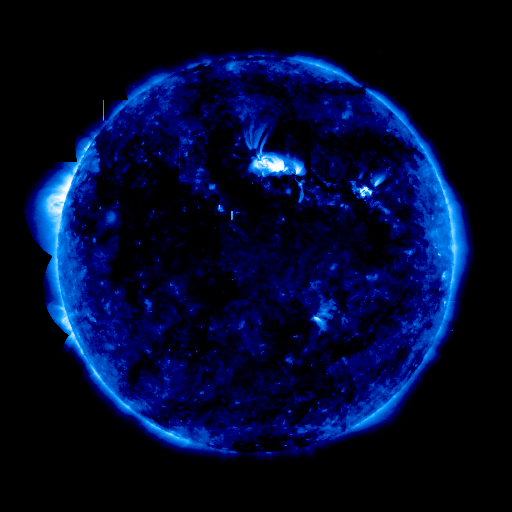
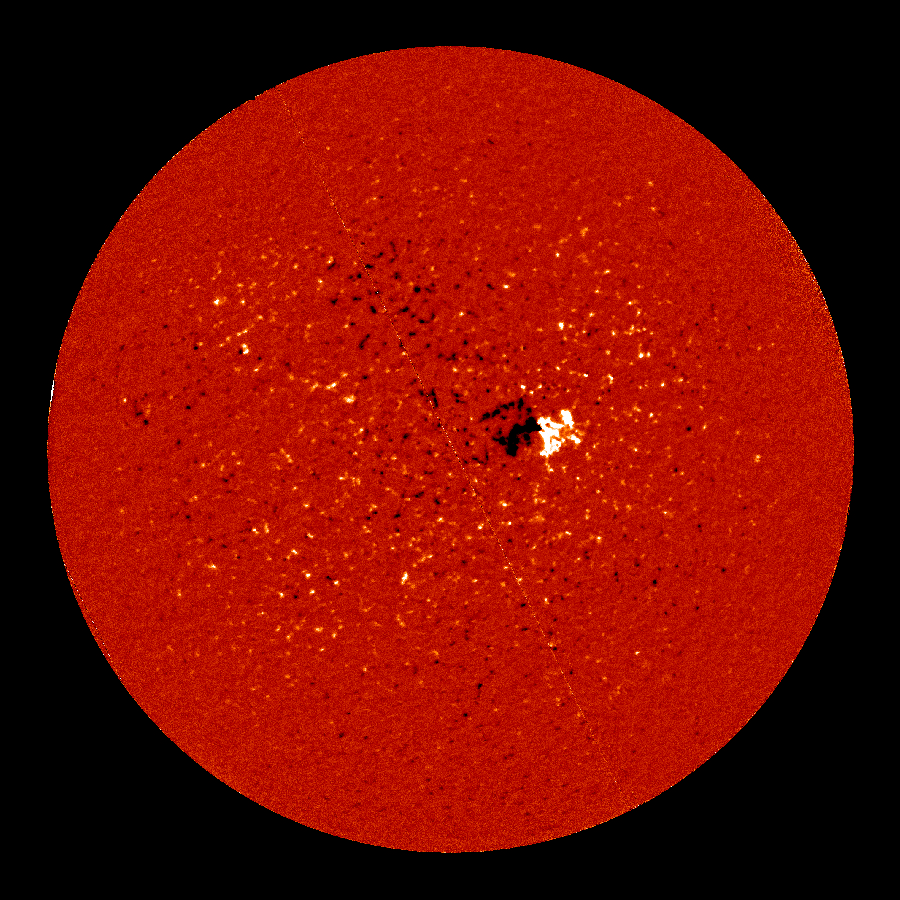
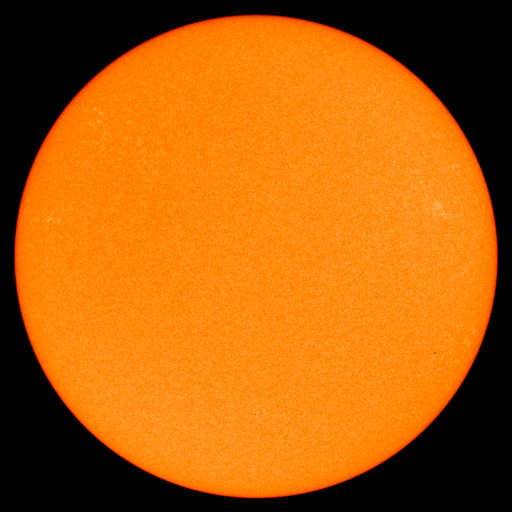
    NASA SDO - X5.4-class Solar Flare, March 7, 2012
    Right at midnight UT time the active region 1429 unleashed a powerful X5.4-class solar flare. X-class flares are the strongest of the flares. They are major ...

    http://fedgeno.com/documents/on-the-relation-between-solar-activity-and-seismicity.pdf

    Seven centuries of records of ancient earthquakes in the Mediterranean region show that the century-scale variations in the number of strong earthquakes closely follow the secular cycle of solar activity. Two well expressed maxima in the global yearly number of earthquakes are seen in the 11-year sunspot cycle - onc coinciding with sunspotmaximum, and the other on the descending phase of solar activity. A day to day study of the number of earthquakes worldwide reveals that the arrival to the Earh of high speed solar streams is related to significantly greater probability of earthquake occurrence.
    The possible mechanism includes deposition of solar wind energy into the polar ionosphere where it drives ionospheric convection and auroral electrojets, generating in ‘turn atmospheric gravity waves that interact with neutral winds and deposit their momentum in the neutral atmosphere, increasing the transfer of air masses and disturbing of the pressure balance on tectonic plates.
    The main sources of high speed solar streams are the solar coronal mass ejections which have a maximum in the sunspot maximum, and the coronal holes with a maximum on the descending phase of solar activity. Both
    coronal holes and CMEs are monitored hy satellite-home
    and ground-based instruments, which makes possible to
    predict periods of enhanced seismic risk.

    http://iopscience.iop.org/0004-637X/727/1/44/fulltext/apj_727_1_44.text.html

    Solar CME speed and geomagnetics. Interesting. (I don't understand it either.) Now I wonder if there could be something to the folk reports of "earthquake clouds".

    http://www.khalilov.biz/pdf/About%20possible%20influence%20of%20solar%20activity%20upon%20seismic%20and%20volcanic%20activities%203.pdf

    It has been determined that in the period of solar activity increase (11-year cycles) there increase seismic and volcanic activities in the compression zone of Earth and at the same time there decreases the activity in the tension zones of Earth.
    On the basis of the discovered stable 11-year and 22-year cyclicalities in the seismic and volcanic activities and their high correlation with solar activity there has been made the long-term forecast until 2018. The next maximum of seismic and volcanic activity with very high amplitude for the compression zones of Earth is forecasted for the period 2012-2015.

    Just the abstract:

    Solar activities play significant roles in electromagnetic coupling of the Sun - Earth system. By comparing the 11-year sunspot cycles and global earthquake events during 1963 to 2010 period, it is possible to reveal the correlation of solar and seismic activities. In the present paper, the monthly values of sunspot cycles number 20 to 23 and earthquake events at different magnitude scales were analyzed to examine the relationship of these values and to understand the coupling mechanisms in solar and geomagnetic activities. The sunspot numbers are obtained from Marshall Space Flight Center, NASA database, and earthquake events are extracted from Advanced National Seismic System (ANSS) database. We found a significant correlation between high speed solar wind (HSSW) and great earthquake events (M ≥ 6.0 Richter scale).
    http://ieeexplore.ieee.org/xpl/freeabs_all.jsp?arnumber=6015869

    The answer, my friend, is blowing in the high-speed solar wind. And stop thinking dirty thoughts about those coupling mechanisms.

    Wednesday, February 29, 2012

    Seismic record

    http://www.kyoshin.bosai.go.jp/kyoshin/topics/html20110311144626/main_20110311144626.html

    Here are some seismic records, in case you want to use the recording on a large turntable-like device to re-play earthquakes.

    One thing I still find amazing yet absolutely accurate is that 5 minutes after the start of the earthquake it is still rocking at an intensity of Shindo 3 over a wide area. 

    Monday, February 27, 2012

    Triple Disaster × 7

     Video isn't very good at capturing an earthquake, but in some cases you get an expressive imprint.

    70th floor of the Landmark Tower in Yokohama. Hundreds of miles from the epicenter, but still...
    http://www.youtube.com/watch?v=n--60WNpKXU
    3.11に横浜ランドマーク展望レストラン


    http://www.youtube.com/watch?v=26cDWmeSH-s
    Miyagi. Since I was underground⇒outside I sometimes wonder what people inside felt. This building makes a surflike sound as it accelerates and you hear the crowd responding to the rollercoaster sensations (2-3g in some places).


    http://www.youtube.com/watch?v=Y8W3AqfOlwk
    It's never a good idea to head down to the river to watch the tsunami come in, but our videographer seems to get just enough time to react to each escalation (with accompanying nonverbal grunts) and ends up OK atop maybe some playground equipment (?) at Minami Kessennuma Elementary School.
    津波を見に行ったら流されそうになったので近くの学校へ退避


    http://www.youtube.com/watch?v=DIR7MvPjY9s
    Going back home to the seaside in Namie where she was born and raised, 5K from the plant, 7 months after.
    【東日本震災から7ヵ月】福島県浪江町の海岸沿い*私の生まれ育った海
    震災7ヵ月後の福島県浪江町請戸地区。福島県第一原発からおよそ5キロ地点です。


    http://www.youtube.com/watch?v=4cv5c66osXY
    Cows inside the 20K perimeter in October '11.
    福島第一原発から20km圏内の牛達が道路を闊歩 2011/10/2
    一時帰宅した時に撮影した野良と化した牛達です。


    http://www.youtube.com/watch?v=oPnVglzxg8g
    He finds the hottest spot at his house in Fukushima City is the rainwater drain at 14.5μSv/h (alarm goes off above 10μSv/h) and he wonders if that will be OK when it only falls to half that after 30 years...
    放射線量測定器のアラームが鳴り止まない~ 福島市渡利
    撮影2011年6月8日  福島市渡利の自宅庭の雨水の溜まり場所では、最高放射線量が14.5μSv/hに達し、放射線量測定器の10μSv/hオーバーを注意


    http://www.youtube.com/watch?v=Mu69Q0suq0Y
    Asphalt is bad but moss is worse -- in Namie.
    放射能汚染浪江町津島
    原発利権屋が許せないですね。山奥の農民に何の罪があるのでしょうか?

    Saturday, February 25, 2012

    Marshall Islanders and Islands, R.I.P.

    http://www.wbez.org/worldview/2012-02-23
    About the 67 nuclear weapons tests in the Marshall islands, including "Bravo" which was 1000 times the size of the Hiroshima bomb and the US govt's deliberately planned (proven by USDOE documents) exposure of the Marshall Islanders who recvd 9 lifetimes of radiation exposure. Over an inch of snow-like radioactive fallout (vaporized coral) fell. Burned, hairless irradiated islanders evacuated after 2-3 days. Listen from minute 6. Extremely racist govt archive audio from minute 13.

    Wednesday, February 22, 2012

    TOP LANDING : TAITO : トップランディング

    nostalgia circa 1989


    http://www.youtube.com/watch?v=eUplJv5Mgzc

    http://www.youtube.com/watch?v=9_YqnZAQ8nE


    Tuesday, February 14, 2012

    How near is here?

    How Tohoku, Kanto, Hokkaido, TEPCO, Kansai, Okinawa, other countries, and politicians see the spread of contamination. This is very accurate. Origin unknown.

    Saturday, February 11, 2012

    Non-intervention in interplanetary affairs

     As the military budget surpasses one trillion dollars, over $3000 per capita, planetary exploration is scaled back (to $4.00 per capita). Soon, we'll have to just be content watching the Chinese missions.

    Obama’s budget would cut Mars program, solar system exploration
    The Obama administration’s budget would hit the NASA division that sends rovers to Mars and probes to Jupiter.
    http://www.washingtonpost.com/national/health-science/presidents-next-budget-to-cut-mars-solar-system-exploration/2012/02/08/gIQAvrm3zQ_story.html

    ▻ Scientists briefed on the proposed budget said that the president’s plan drops funding for planetary science at NASA from $1.5 billion this year to $1.2 billion next year, with further cuts continuing through 2017.

    Sunday, October 16, 2011

    Home radiometry results

     after testing house for radiation October 16

    Our house and garden seems to be around 0.11-0.14 microsieverts/hr, according to my friend's dosimeter. It's lower as you go up closer to the roof and eaves, not higher as with some houses. Inside is not much different than outside. We tested the sandbox in the park and at the daycare next door, and it was about the same.

    He has found 0.2, 0.3, and 0.4 in Chiba. In one case a house in Matsudo had those numbers for the first, second floor, and eaves, respectively. There is a spot along the river in Noda-shi where he measures 0.4. The hot spot in Andersen Park was 0.5 microsieverts/hr. Reality is about 3 times the silly numbers the gov't reports as seen at http://www.japantimes.co.jp/radiation-levels.html

    I don't really need to strip all organic material and topsoil from the garden, because it is not any more or less radioactive than the surrounding area, and it would eventually become the same anyway. And if i did collect radioactivity in my rain catchment system, it was probably radioactive iodine, which would have decayed by now. Hot spots which exist in Chiba are about 6 miles or 10k north of here.

    Saturday, October 01, 2011

    "Contaminated Zone" in Chiba

    Radiation spread reaches Chiba, Saitama prefectures - AJW by The Asahi Shimbun

    » In Chiba Prefecture, the highest levels of cesium-137, between 30,000 and 60,000 becquerels per square meter, were detected in northern areas, such as Kashiwa, Matsudo, Abiko and Nagareyama. Cesium-137 has a half-life of 30 years.
    In the 1986 Chernobyl nuclear accident, areas with 37,000 becquerels or more of radioactivity per square meter were designated contaminated zones, while levels of 555,000 becquerels or more required forcible relocation.
    In Chiba and Saitama prefectures, the highest radiation levels were 0.2 to 0.5 microsievert per hour. In most other areas, the radiation levels were 0.1 microsievert or less.
    http://ajw.asahi.com/article/0311disaster/fukushima/AJ2011093012746